
Crypto Cards
Início
SobreContatoPortal de empresas
Início
Cartões Sem KYCCartões EmpresariaisCartões BitcoinCartões XRP
🇮🇳Índia🇨🇦Canadá🇦🇺Austrália🇬🇧Reino Unido🇪🇺Europa🇳🇱Países Baixos🇦🇪Emirados Árabes Unidos🇸🇬Cingapura🇳🇬Nigéria
SobreContatoPortal de empresas
Crypto Cards

Compare cartões de crédito cripto por taxas, requisitos de KYC, pontuações de privacidade e recursos.

Cartões

  • Início
  • Cartões Sem KYC
  • Cartões Empresariais
  • Cartões Bitcoin
  • Cartões XRP

Países

  • Índia
  • Canadá
  • Austrália
  • Reino Unido
  • Europa
  • Países Baixos
  • Emirados Árabes Unidos
  • Cingapura
  • Nigéria

Empresa

  • Sobre
  • Como Avaliamos
  • Contato

Legal

  • Termos e Condições
  • Política de Privacidade

2026 Crypto Cards. Todos os direitos reservados.

Os dados são fornecidos apenas para fins informativos. Sempre faça sua própria pesquisa.

  1. Início
  2. /
  3. Cartões
  4. /
  5. Payy Card
Payy Card
Payy Card
Verificação de ID
Cartão Virtual Visa
8.5
Geral
Obter Cartão
Payy Card logo

Payy Card

por Payy

Cartão Virtual•Visa•Verificação de ID
Obter Cartão

O Payy Card é o primeiro cartão cripto com preservação de privacidade que utiliza zero-knowledge proofs, desenvolvido por ex-engenheiros da Apple. Perfeito para usuários preocupados com a privacidade que desejam gastar stablecoins sem expor atividades on-chain.

Prós

  • +Zero-knowledge proofs ocultam a atividade da carteira nas transações do cartão
  • +Self-custodial - os fundos não podem ser congelados ou suspensos
  • +Sem taxas mensais, de transação ou de recarga
  • +Funciona com OpenAI, Netflix, Spotify (muitos cartões não funcionam)
  • +Design exclusivo de cartão físico que acende

Contras

  • -Taxa de câmbio de 1% em compras internacionais
  • -O cartão físico é apenas por aproximação (sem chip/tarja)
  • -Sem programa de cashback ou recompensas
  • -Apenas USDC - suporte limitado a criptomoedas
  • -O conjunto de recursos minimalista pode não atender a todos os usuários
8.5/10
GeralExcelente
5.8/10
Pontuação da ComunidadeBaseado em 37 fontes
Lv 3
Nível KYCVerificação de ID

Índice

Visão Geral do Cartão
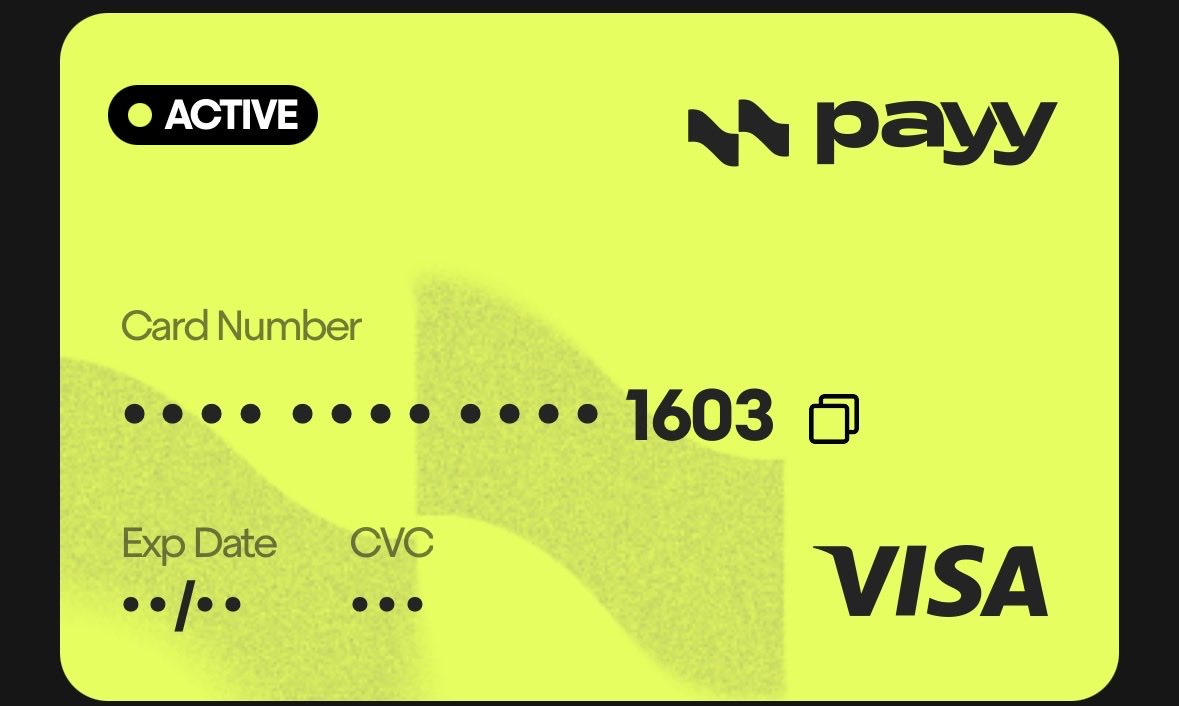
Payy Card
Recompensas
Cashback
0%
Cashback Cripto
—
Recompensas de Staking
✗
APR de Staking
—
Bônus de Boas-vindas
—
Bônus de Indicação
$0
Taxas
Taxa Mensal
Grátis
Emissão do Cartão
Grátis
Taxa de Caixa Eletrônico
Grátis
Taxa de Câmbio
Grátis
Taxa de Recarga
Grátis
CompareCards.declineFee
Grátis
Limites
Gasto Diário
Ilimitado
Gasto Mensal
Ilimitado
Saque em Caixa Eletrônico
Ilimitado
Info do Cartão
Tipo de Cartão
Cartão Virtual, Cartão Físico
Rede do Cartão
Visa
CompareCards.applePay
✓
CompareCards.googlePay
✓
Recompensas
Cashback
0%
Cashback Cripto
—
Recompensas de Staking
✗
APR de Staking
—
Bônus de Boas-vindas
—
Bônus de Indicação
$0
Taxas
Taxa Mensal
Grátis
Emissão do Cartão
Grátis
Taxa de Caixa Eletrônico
Grátis
Taxa de Câmbio
Grátis
Taxa de Recarga
Grátis
CompareCards.declineFee
Grátis
Limites
Gasto Diário
Ilimitado
Gasto Mensal
Ilimitado
Saque em Caixa Eletrônico
Ilimitado
Info do Cartão
Tipo de Cartão
Cartão Virtual, Cartão Físico
Rede do Cartão
Visa
CompareCards.applePay
✓
CompareCards.googlePay
✓

Requisitos de KYC

Level: Verificação de ID
Verificação de Email
Obrigatório
Verificação de Telefone
Obrigatório
Documento de Identidade
Obrigatório
Comprovante de Endereço
Não Obrigatório
Verificação por Selfie
Não Obrigatório

Pontuação da Comunidade

5.8/10
Fontes
@r/defi community“Thread on moving a USDC salary to family overseas. Commenters recommend loading a Payy card for recipients in places like Indonesia and Brazil so money can be spent directly at Visa merchants instead of paying wire-transfer fees and waiting on correspondent banks. Framed purely as a remittance tool, with the zero-knowledge layer going unmentioned; the practical appeal is that the recipient needs no bank relationship of their own.”@r/AskArgentina posters“Locals asking whether anyone has actually used the wallet, prompted by X ads promising steep discounts on international subscriptions such as ChatGPT and Notion. Responses are sceptical, as nobody in the thread can vouch for the platform first-hand, and the advertised savings turn out to be a tax artefact rather than a platform subsidy: paying in USD-denominated stablecoins sidesteps the surcharge Argentina applies to foreign-currency purchases on local fiat cards.”@r/payy subreddit“Small product subreddit carrying how-to posts and first-hand setup experiences. Volume is low relative to larger crypto-card communities, which limits how much can be inferred from it, but the threads that exist skew toward practical onboarding questions rather than complaints.”@Independent crypto reviewer“Review built around the claim that the card makes its holder invisible on-chain. Emphasis falls on the break between physical retail spending and a wallet visible history, and on achieving that without the sanctions exposure attached to mixer-style tools. The presenter treats compliance-preserving privacy as the product entire reason to exist.”@Zero Knowledge podcast, with the Payy founding team“Long-form technical episode covering the migration to Noir circuits with Barretenberg proving, the sparse Merkle structure that stores unspent commitments and spent nullifiers in one authenticated tree, and the bridge contract reconciling proofs against public EVM state. The audience is cryptography-literate and the tone is peer review rather than promotion; the architecture holds up under it.”@Interview with Sid Gandhi, Payy CEO“Framing interview arguing that transparent ledgers are the real blocker to stablecoin payroll and treasury use, since sending on a public chain is equivalent to publishing a bank statement. Positions privacy as a precondition for mainstream adoption rather than a niche feature. Founder-led, so the claims go unchallenged.”@Crypto creator, short-form“Clarification piece addressing confusion over how a privacy card can also require identity verification. Explains that KYC is collected for card issuance while on-chain activity stays shielded, and cautions that hiding spending from analytics firms removes no obligation to declare holdings or gains to a tax authority.”@Crypto commentary channel“Broader argument that institutional adoption of digital assets depends on transaction privacy, using Payy as a worked example of compliant shielding. Only tangentially about the card; useful mainly as evidence the privacy thesis circulates beyond the project own audience.”@Google Play reviewers“Listing for the Polybase Labs wallet, rated in the high-3s to low-4s across a few hundred reviews on more than 50,000 installs. Positive reviews describe a product that feels like a neobank rather than a protocol dashboard, with peer-to-peer links letting a recipient claim funds without owning a wallet first. Negative reviews cluster tightly on two defects: money disappearing between deposit and balance, and a recovery loop after reinstalling.”@Akbor Hosen, MD SIAM (HASSAN) and other reviewers“English-locale review feed carrying the two most-cited complaints. A July 2026 reviewer reports the app demanding a manual seed-phrase recovery on every single launch after reinstalling, making it unusable for daily spending. An April 2026 reviewer documents a deposit arriving materially smaller than the amount sent, with no itemisation anywhere in the interface, concluding the system is misleading. Neither received a substantive response.”@App Store reviewers (US)“US storefront listing rated around 4.2 on a modest review count. Praise centres on how little the app asks of the user, with no username or password and a card provisioned to Apple Pay in minutes, and on subscription services accepting the BIN where other crypto cards get declined. Criticism mirrors Android: opaque deposit deductions and no way back in when automated identity checks misfire.”@App Store reviewers (Argentina storefront)“Argentine listing, relevant because this is the market where the card practical value is highest. Reviewers treat it as a way to pay for USD-priced services without the local card surcharge; recurring frustrations are physical card availability in-region and thin Spanish-language support.”@App Store reviewers (Germany storefront)“German storefront listing. European reviewers weigh the privacy design against regulatory uncertainty under MiCA and travel-rule obligations, and several note the physical card has been hard to obtain. App quality itself rates well.”@Trustpilot reviewers“Thin but pointed review set dominated by support failures. The most detailed entry, from May 2026, describes a ticket auto-closed as a duplicate and no reply across in-app messaging, email, or public escalation to the company own X account. Positive entries exist and praise fees and speed, but volume is small enough that one bad experience carries disproportionate weight.”@SpendNode“Aggregator profile documenting the fee schedule in detail: nothing charged for application, top-up, transaction or monthly maintenance, the only recurring cost a roughly 1% FX markup on non-USD spending, and no spread applied converting stablecoins to dollars. Daily spending is bounded by balance rather than a policy cap.”@SpendNode“Companion card-specific page covering issuance and daily use: a virtual card available almost immediately after verification, Apple Pay and Google Pay provisioning, and acceptance at recurring-billing merchants. Names the complete absence of a cashback programme as the main trade-off against the fee structure.”@Cryptonoshi“Scored review rating the product well on custody, privacy and cost while marking support down to roughly 3.9 out of 10, the single lowest component in the write-up. Response times of eight to forty-eight hours are cited alongside tickets closed without resolution.”@OpenCryptoCards“Directory entry confirming the self-custodial model, Visa debit rails and the KYC-for-issuance-only approach. Presented as one of very few cards where privacy is a property of the settlement layer rather than of a privacy policy.”@CryptoCardHub“Comparison-table listing placing the card against mainstream custodial competitors. It stands out on custody and privacy, sits at the bottom of the table on rewards, and is flagged as early-stage relative to established issuers.”@CoinCodeCap“Combined network and wallet review, positive on onboarding speed and the absence of recurring fees but more cautious about dependency on a single purpose-built chain, noting that a card tied to a bespoke rollup inherits that rollup liveness risk.”@VirtualCardX“Review pitched at readers hunting for minimal-verification virtual cards. Accurate that no email, phone or password is required, but it qualifies the framing: a government ID scan and selfie remain mandatory before a card is issued, making this light KYC rather than no KYC.”@TAMradar“Funding-round entry recording a 6 million dollar seed and sizing the opportunity against a stablecoin market near 300 billion dollars, with widely cited projections running into the trillions by decade end. Positions ledger transparency as the specific bottleneck the raise is meant to address.”@FF News (Fintech Finance)“Trade-press coverage of the seed round led by FirstMark Capital with Robot Ventures and DBA Crypto participating. Frames the thesis for a fintech audience: private settlement is what makes stablecoin payroll and treasury operations viable for businesses that cannot publish their cash flows.”@Crowdfund Insider“March 2026 report on the raise citing traction of roughly 100,000 verified users across 120 countries and annualised volume near 130 million dollars. Coverage is descriptive and largely sourced from the announcement rather than independent reporting.”@Pulse 2.0“Short funding write-up emphasising the privacy-first positioning and the investor roster. Adds no critical assessment, and is representative of how uniformly favourable the syndicated funding coverage has been.”@Cointelegraph, via TradingView“Launch coverage of the Ethereum L2 with privacy built into the base layer rather than bolted on at the application level. Explains the self-custodial wallet pairing and notes that shielding is the default state rather than an opt-in mode.”@Protocol Labs“Ecosystem essay arguing privacy is the unlock for real-world stablecoin adoption, using the card as the consumer-facing proof. Written from an investor-adjacent position and therefore favourable, though the technical claims about shielded settlement are specific rather than hand-waved.”@Bankless“Practitioner walkthrough of spending stablecoins without broadcasting balances, covering funding, the shielded transfer step and everyday card use. Aimed at readers who already hold crypto and want mechanics rather than a pitch.”@Cobo“Macro piece on stablecoin regulation and jurisdictional competition over digital currency. Payy appears only as an example of privacy-preserving infrastructure; the relevance is the warning that travel-rule and MiCA obligations will keep tightening around exactly this category of product.”@IQ.wiki contributors“Community-maintained encyclopedia entry summarising the network, the Polybase Labs team and the card product. Factual and largely uncritical, useful as a neutral reference point on what the project claims about itself.”@Privy engineering documentation“Integration recipe showing how embedded-wallet authentication is wired into the network, letting a third-party application onboard users without exposing seed phrases. Cited by developers as evidence the stack is genuinely integrable rather than closed.”@Across Protocol“Announcement of cross-chain deposits into the network, addressing the most-cited friction point for the card: funds must sit on a bespoke L2, so users arriving from mainnet or another rollup previously had to bridge manually. Describes the resulting experience in Venmo terms.”@Aztec Protocol“Reference material on the Noir circuit language the network migrated to from its earlier proving stack. Not about the card, but it underpins developer claims that circuit work became substantially more approachable after the switch.”@Token Terminal“Fundraising dataset used to corroborate the seed round independently of the project own announcement. Data only, no commentary.”@Kulipa“Industry analysis of embedded wallets as the on-ramp for mainstream stablecoin payments, with Payy cited among the implementations. Sector-level rather than product-level, positioning the card as one instance of a broader pattern.”@FinTech Forum“European B2B fintech industry blog tracking startups and the banks, insurers and investors backing them. Payy appears in ecosystem coverage rather than as a review subject; included as a trace of how the project registers with a non-crypto fintech audience.”@@alistrago_crypt“Representative of the small pool of organic X commentary. Argues the card is one of the few crypto products usable in ordinary daily life and wonders why adoption is not higher given the absence of cashback campaigns and paid promotion. Affiliate-adjacent, so discounted accordingly, though the observation about low organic volume is corroborated elsewhere.”

Payy Card scores 5.8/10 across 37 community sources, unifying two independent deep-research passes. It is the rare card where privacy is architectural rather than marketing: a purpose-built ZK-rollup hides sender, receiver and amount by default, keys stay on the device, and card spending cannot be correlated with on-chain wallet history. That is the one axis where technical reviewers and retail users fully agree. Onboarding is genuinely fast, an ID scan and selfie with often no email, phone or password, and a virtual card issued in minutes. The headline fee schedule is close to best-in-class, with nothing charged for issuance, top-ups, transactions or monthly maintenance and only a roughly 1% FX markup on non-USD spending. Execution is where sentiment splits hard. Android users report a wallet-recovery loop that forces a seed-phrase restore on every launch after reinstalling, and multiple reviewers document deposits arriving materially smaller than the amount sent with no itemisation of bridge gas anywhere in the interface. Rewards are effectively absent, since Payy Points accrue for holding balance and referrals but carry no monetary value and there is no spend-based cashback. Support is the clearest failure: replies taking 8 to 48 hours, tickets auto-closed as duplicates, and because no email or phone is tied to an account, a mis-read identity document can lock a user out permanently with no override path.

Detalhamento por Categoria

Simplicidade do KYC
7/10
Eficiência de Taxas
8/10
Valor das Recompensas
3/10
Experiência do App
6/10
Privacidade
9/10
Qualidade do Suporte
2/10

Recursos

Sem Contato

Criptomoedas Suportadas

USDC iconUSDC