
Crypto Cards
首页
关于我们联系我们企业中心
首页
免 KYC 卡商务卡比特币卡XRP 卡
🇮🇳印度🇨🇦加拿大🇦🇺澳大利亚🇬🇧英国🇪🇺欧洲🇳🇱荷兰🇦🇪阿联酋🇸🇬新加坡🇳🇬尼日利亚
关于我们联系我们企业中心
Crypto Cards

按费用、KYC 要求、隐私评分与功能对比加密货币信用卡。

卡片

  • 首页
  • 免 KYC 卡
  • 商务卡
  • 比特币卡
  • XRP 卡

国家/地区

  • 印度
  • 加拿大
  • 澳大利亚
  • 英国
  • 欧洲
  • 荷兰
  • 阿联酋
  • 新加坡
  • 尼日利亚

公司

  • 关于我们
  • 评分方法
  • 联系我们

法律条款

  • 条款与条件
  • 隐私政策

2026 Crypto Cards. 保留所有权利。

本站数据仅供参考,请务必自行核实研究。

  1. 首页
  2. /
  3. 卡片
  4. /
  5. Payy Card
Payy Card
Payy Card
证件验证
虚拟卡 Visa
8.5
综合
获取此卡
Payy Card logo

Payy Card

发行方 Payy

虚拟卡•Visa•证件验证
获取此卡

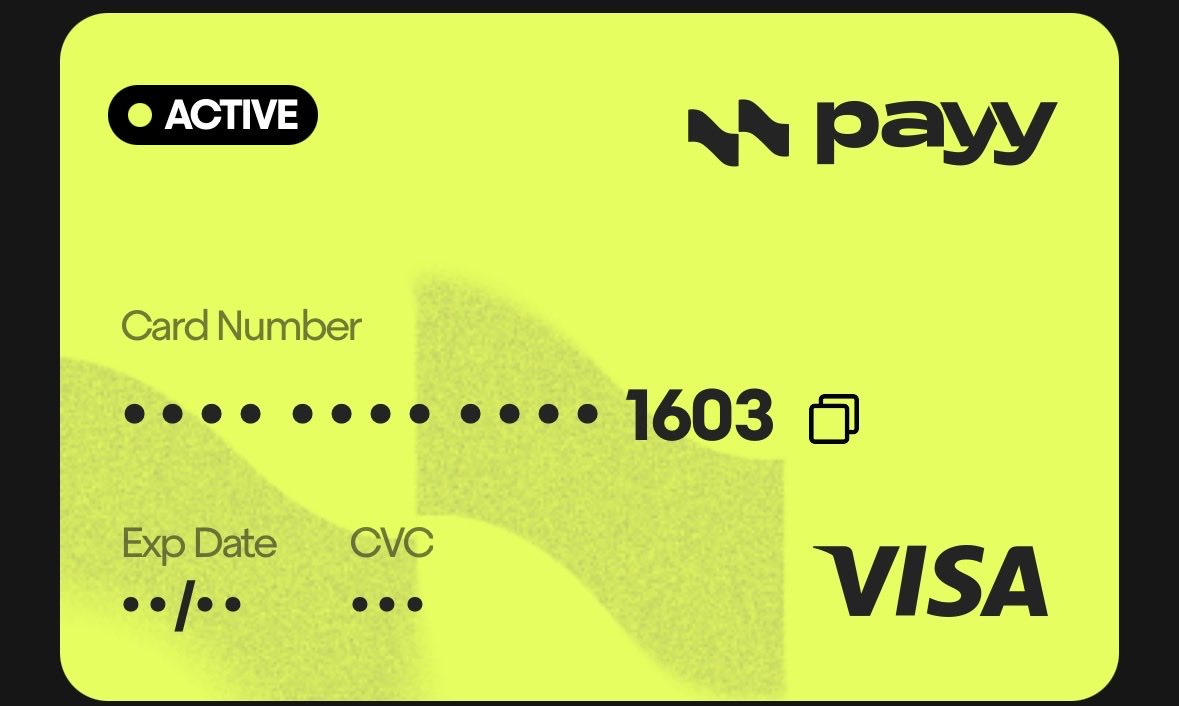
Payy Card 是首张采用零知识证明保护隐私的加密货币卡,由前苹果工程师打造。它非常适合希望消费稳定币又不想暴露链上活动的隐私敏感用户。

优点

  • +零知识证明可让卡片交易与钱包活动脱钩
  • +自托管,资金不会被冻结或停用
  • +免月费、交易费与充值费
  • +可用于 OpenAI、Netflix、Spotify(许多卡片无法使用)
  • +独特的发光实体卡设计

缺点

  • -境外消费收取 1% 外汇手续费
  • -实体卡仅支持闪付(无芯片与磁条)
  • -没有返现或奖励计划
  • -仅支持 USDC,加密货币种类有限
  • -功能极简,未必适合所有用户
8.5/10
综合优秀
5.8/10
社区评分基于 37 个信息来源
Lv 3
KYC 等级证件验证

目录

卡片概览

Payy Card
奖励
返现
0%
返现币种
—
质押奖励
✗
质押年化收益
—
新用户奖励
—
推荐奖励
$0
费用
月费
免费
开卡费
免费
ATM 取现费
免费
外汇兑换费
免费
充值费
免费
交易拒付费
免费
限额
每日消费
不限额
每月消费
不限额
ATM 取现
不限额
卡片信息
卡片类型
虚拟卡, 实体卡
卡组织
Visa
Apple Pay
✓
Google Pay
✓
奖励
返现
0%
返现币种
—
质押奖励
✗
质押年化收益
—
新用户奖励
—
推荐奖励
$0
费用
月费
免费
开卡费
免费
ATM 取现费
免费
外汇兑换费
免费
充值费
免费
交易拒付费
免费
限额
每日消费
不限额
每月消费
不限额
ATM 取现
不限额
卡片信息
卡片类型
虚拟卡, 实体卡
卡组织
Visa
Apple Pay
✓
Google Pay
✓

KYC 要求

Level: 证件验证
邮箱验证
需要
手机验证
需要
身份证件
需要
地址证明
不需要
自拍验证
不需要

社区评分

5.8/10
来源于
@r/defi community“Thread on moving a USDC salary to family overseas. Commenters recommend loading a Payy card for recipients in places like Indonesia and Brazil so money can be spent directly at Visa merchants instead of paying wire-transfer fees and waiting on correspondent banks. Framed purely as a remittance tool, with the zero-knowledge layer going unmentioned; the practical appeal is that the recipient needs no bank relationship of their own.”@r/AskArgentina posters“Locals asking whether anyone has actually used the wallet, prompted by X ads promising steep discounts on international subscriptions such as ChatGPT and Notion. Responses are sceptical, as nobody in the thread can vouch for the platform first-hand, and the advertised savings turn out to be a tax artefact rather than a platform subsidy: paying in USD-denominated stablecoins sidesteps the surcharge Argentina applies to foreign-currency purchases on local fiat cards.”@r/payy subreddit“Small product subreddit carrying how-to posts and first-hand setup experiences. Volume is low relative to larger crypto-card communities, which limits how much can be inferred from it, but the threads that exist skew toward practical onboarding questions rather than complaints.”@Independent crypto reviewer“Review built around the claim that the card makes its holder invisible on-chain. Emphasis falls on the break between physical retail spending and a wallet visible history, and on achieving that without the sanctions exposure attached to mixer-style tools. The presenter treats compliance-preserving privacy as the product entire reason to exist.”@Zero Knowledge podcast, with the Payy founding team“Long-form technical episode covering the migration to Noir circuits with Barretenberg proving, the sparse Merkle structure that stores unspent commitments and spent nullifiers in one authenticated tree, and the bridge contract reconciling proofs against public EVM state. The audience is cryptography-literate and the tone is peer review rather than promotion; the architecture holds up under it.”@Interview with Sid Gandhi, Payy CEO“Framing interview arguing that transparent ledgers are the real blocker to stablecoin payroll and treasury use, since sending on a public chain is equivalent to publishing a bank statement. Positions privacy as a precondition for mainstream adoption rather than a niche feature. Founder-led, so the claims go unchallenged.”@Crypto creator, short-form“Clarification piece addressing confusion over how a privacy card can also require identity verification. Explains that KYC is collected for card issuance while on-chain activity stays shielded, and cautions that hiding spending from analytics firms removes no obligation to declare holdings or gains to a tax authority.”@Crypto commentary channel“Broader argument that institutional adoption of digital assets depends on transaction privacy, using Payy as a worked example of compliant shielding. Only tangentially about the card; useful mainly as evidence the privacy thesis circulates beyond the project own audience.”@Google Play reviewers“Listing for the Polybase Labs wallet, rated in the high-3s to low-4s across a few hundred reviews on more than 50,000 installs. Positive reviews describe a product that feels like a neobank rather than a protocol dashboard, with peer-to-peer links letting a recipient claim funds without owning a wallet first. Negative reviews cluster tightly on two defects: money disappearing between deposit and balance, and a recovery loop after reinstalling.”@Akbor Hosen, MD SIAM (HASSAN) and other reviewers“English-locale review feed carrying the two most-cited complaints. A July 2026 reviewer reports the app demanding a manual seed-phrase recovery on every single launch after reinstalling, making it unusable for daily spending. An April 2026 reviewer documents a deposit arriving materially smaller than the amount sent, with no itemisation anywhere in the interface, concluding the system is misleading. Neither received a substantive response.”@App Store reviewers (US)“US storefront listing rated around 4.2 on a modest review count. Praise centres on how little the app asks of the user, with no username or password and a card provisioned to Apple Pay in minutes, and on subscription services accepting the BIN where other crypto cards get declined. Criticism mirrors Android: opaque deposit deductions and no way back in when automated identity checks misfire.”@App Store reviewers (Argentina storefront)“Argentine listing, relevant because this is the market where the card practical value is highest. Reviewers treat it as a way to pay for USD-priced services without the local card surcharge; recurring frustrations are physical card availability in-region and thin Spanish-language support.”@App Store reviewers (Germany storefront)“German storefront listing. European reviewers weigh the privacy design against regulatory uncertainty under MiCA and travel-rule obligations, and several note the physical card has been hard to obtain. App quality itself rates well.”@Trustpilot reviewers“Thin but pointed review set dominated by support failures. The most detailed entry, from May 2026, describes a ticket auto-closed as a duplicate and no reply across in-app messaging, email, or public escalation to the company own X account. Positive entries exist and praise fees and speed, but volume is small enough that one bad experience carries disproportionate weight.”@SpendNode“Aggregator profile documenting the fee schedule in detail: nothing charged for application, top-up, transaction or monthly maintenance, the only recurring cost a roughly 1% FX markup on non-USD spending, and no spread applied converting stablecoins to dollars. Daily spending is bounded by balance rather than a policy cap.”@SpendNode“Companion card-specific page covering issuance and daily use: a virtual card available almost immediately after verification, Apple Pay and Google Pay provisioning, and acceptance at recurring-billing merchants. Names the complete absence of a cashback programme as the main trade-off against the fee structure.”@Cryptonoshi“Scored review rating the product well on custody, privacy and cost while marking support down to roughly 3.9 out of 10, the single lowest component in the write-up. Response times of eight to forty-eight hours are cited alongside tickets closed without resolution.”@OpenCryptoCards“Directory entry confirming the self-custodial model, Visa debit rails and the KYC-for-issuance-only approach. Presented as one of very few cards where privacy is a property of the settlement layer rather than of a privacy policy.”@CryptoCardHub“Comparison-table listing placing the card against mainstream custodial competitors. It stands out on custody and privacy, sits at the bottom of the table on rewards, and is flagged as early-stage relative to established issuers.”@CoinCodeCap“Combined network and wallet review, positive on onboarding speed and the absence of recurring fees but more cautious about dependency on a single purpose-built chain, noting that a card tied to a bespoke rollup inherits that rollup liveness risk.”@VirtualCardX“Review pitched at readers hunting for minimal-verification virtual cards. Accurate that no email, phone or password is required, but it qualifies the framing: a government ID scan and selfie remain mandatory before a card is issued, making this light KYC rather than no KYC.”@TAMradar“Funding-round entry recording a 6 million dollar seed and sizing the opportunity against a stablecoin market near 300 billion dollars, with widely cited projections running into the trillions by decade end. Positions ledger transparency as the specific bottleneck the raise is meant to address.”@FF News (Fintech Finance)“Trade-press coverage of the seed round led by FirstMark Capital with Robot Ventures and DBA Crypto participating. Frames the thesis for a fintech audience: private settlement is what makes stablecoin payroll and treasury operations viable for businesses that cannot publish their cash flows.”@Crowdfund Insider“March 2026 report on the raise citing traction of roughly 100,000 verified users across 120 countries and annualised volume near 130 million dollars. Coverage is descriptive and largely sourced from the announcement rather than independent reporting.”@Pulse 2.0“Short funding write-up emphasising the privacy-first positioning and the investor roster. Adds no critical assessment, and is representative of how uniformly favourable the syndicated funding coverage has been.”@Cointelegraph, via TradingView“Launch coverage of the Ethereum L2 with privacy built into the base layer rather than bolted on at the application level. Explains the self-custodial wallet pairing and notes that shielding is the default state rather than an opt-in mode.”@Protocol Labs“Ecosystem essay arguing privacy is the unlock for real-world stablecoin adoption, using the card as the consumer-facing proof. Written from an investor-adjacent position and therefore favourable, though the technical claims about shielded settlement are specific rather than hand-waved.”@Bankless“Practitioner walkthrough of spending stablecoins without broadcasting balances, covering funding, the shielded transfer step and everyday card use. Aimed at readers who already hold crypto and want mechanics rather than a pitch.”@Cobo“Macro piece on stablecoin regulation and jurisdictional competition over digital currency. Payy appears only as an example of privacy-preserving infrastructure; the relevance is the warning that travel-rule and MiCA obligations will keep tightening around exactly this category of product.”@IQ.wiki contributors“Community-maintained encyclopedia entry summarising the network, the Polybase Labs team and the card product. Factual and largely uncritical, useful as a neutral reference point on what the project claims about itself.”@Privy engineering documentation“Integration recipe showing how embedded-wallet authentication is wired into the network, letting a third-party application onboard users without exposing seed phrases. Cited by developers as evidence the stack is genuinely integrable rather than closed.”@Across Protocol“Announcement of cross-chain deposits into the network, addressing the most-cited friction point for the card: funds must sit on a bespoke L2, so users arriving from mainnet or another rollup previously had to bridge manually. Describes the resulting experience in Venmo terms.”@Aztec Protocol“Reference material on the Noir circuit language the network migrated to from its earlier proving stack. Not about the card, but it underpins developer claims that circuit work became substantially more approachable after the switch.”@Token Terminal“Fundraising dataset used to corroborate the seed round independently of the project own announcement. Data only, no commentary.”@Kulipa“Industry analysis of embedded wallets as the on-ramp for mainstream stablecoin payments, with Payy cited among the implementations. Sector-level rather than product-level, positioning the card as one instance of a broader pattern.”@FinTech Forum“European B2B fintech industry blog tracking startups and the banks, insurers and investors backing them. Payy appears in ecosystem coverage rather than as a review subject; included as a trace of how the project registers with a non-crypto fintech audience.”@@alistrago_crypt“Representative of the small pool of organic X commentary. Argues the card is one of the few crypto products usable in ordinary daily life and wonders why adoption is not higher given the absence of cashback campaigns and paid promotion. Affiliate-adjacent, so discounted accordingly, though the observation about low organic volume is corroborated elsewhere.”

Payy Card 在 37 个社区信息来源中获得 5.8/10 的评分,整合自两轮独立深度研究。它是少见的把隐私做进架构、而非停留在营销层面的卡片:专门构建的零知识 Rollup 默认隐藏发送方、接收方与金额,密钥始终留在设备上,卡片消费也无法与链上钱包记录相关联。这是技术评测者与零售用户完全一致认可的一点。开通确实很快,扫描证件加一张自拍,往往连邮箱、手机号与密码都不需要,几分钟内即可开出虚拟卡。其公开费率接近同类最佳:开卡、充值、交易与月度管理全部免费,仅对非美元消费收取约 1% 的外汇加价。但在执行层面,口碑严重分化。Android 用户反映重装后每次启动都会陷入必须用助记词恢复钱包的死循环,多位评测者还记录到实际到账金额明显少于转入金额,而界面上任何地方都没有列明跨链 Gas 费。奖励基本形同虚设,Payy 积分只按余额与推荐累积,没有货币价值,也没有基于消费的返现。客服是最明显的失败:回复要等 8 至 48 小时,工单被当作重复项自动关闭;而由于账户不绑定邮箱或手机号,一旦身份证件被误读,用户可能被永久锁在门外,且没有任何人工覆核通道。

分项评分

KYC 便捷度
7/10
费用性价比
8/10
奖励价值
3/10
App 体验
6/10
隐私
9/10
客服质量
2/10

功能

闪付(非接触支付)

支持的加密货币

USDC iconUSDC