Crypto Taxes When You Spend Crypto: Cards, Stablecoins and Cashback, Country by Country (2026)
Is paying with a crypto card taxable? How card spending, stablecoins and cashback are taxed in 13 countries, including the US, UK, EU, Canada and Australia, with the rules as of October 2026.

13 min read
We may earn a commission when you sign up through links on this page. It never affects how we rate cards. How we rate
Key takeaways
- In most countries, paying with a crypto card counts as selling crypto. You owe tax on any gain since you bought the coins.
- With stablecoins the gain is usually tiny or zero, but in many countries you still have to record each sale.
- Cashback has almost no official rules anywhere. Most advisers treat it as a discount, not income, but you can owe tax when you later sell it.
- The UAE, Singapore and Switzerland don't tax private crypto gains. Germany and Portugal don't tax coins held longer than one year.
- New in 2026: crypto companies in the EU and the UK now report your activity to tax authorities, and US brokers send Form 1099-DA.
Every time you tap a crypto card, you're most likely selling crypto. The card sells your coins for local money at checkout, and in most countries that sale is a taxable event. It doesn't matter that you only bought a coffee.
That adds up fast. The average crypto card purchase is about $89, and 70% of the 129 cards we review let you spend coins like Bitcoin or Ether, whose price moves. Someone who pays by card 30 times a month makes 360 taxable sales a year.
This post explains how card spending, stablecoins and cashback are taxed in 13 countries, with the rules as they stand in October 2026.
How a card purchase becomes a taxable event
You pay with your crypto card. The card sells enough of your crypto to cover the price.
That sale is a "disposal". Tax authorities treat it like selling the coins for cash.
You owe tax on the gain. The gain is the price of what you bought minus what you originally paid for the coins you used.
Example 1: paying with Ether
You bought 0.1 ETH at $2,000 per ETH. Later, when ETH is at $3,000, you pay for an $89 dinner with your card.
| Amount | |
|---|---|
| ETH sold to pay the bill | 0.0297 ETH |
| What that ETH cost you | $59.33 |
| What it was worth when you paid | $89.00 |
| Taxable gain | $29.67 |
So a normal dinner created a $29.67 gain you have to report.
Example 2: paying with USDC
Same $89 dinner, paid with USDC you bought at $1.00. The gain is $0, because the coins are worth what you paid.
There's one catch. Your tax is calculated in your own currency. If you live in the eurozone, the UK, Canada or Australia, a dollar stablecoin can still make a small gain or loss when exchange rates move.
| (example rates) | Amount |
|---|---|
| You buy 100 USDC when €1 = $1.10. Cost of 89 USDC | €80.91 |
| You spend 89 USDC when €1 = $1.05. Value | €84.76 |
| Taxable gain | €3.85 |
Small, but not zero, and it repeats on every purchase.
Example 3: it adds up
30 card payments a month means 360 disposals a year. For each one you need the date, the amount, and the cost of the exact coins you used. Doing that by hand in a spreadsheet takes a lot of time and is easy to get wrong.
Cashback: income or discount?
None of the 13 tax authorities we checked has written rules about cashback from crypto card spending. Here's what applies instead:
Cashback from your own spending is usually treated as a discount. The logic is the same as cashback on a normal credit card: you're getting part of the purchase price back, not earning money. This is the common professional view in the US, UK, Germany and Australia.
Sign-up and referral bonuses are different. They're usually taxable income in the countries that tax income.
Selling the cashback later can be taxable. If your cashback is paid in Bitcoin and the price goes up before you spend it, that gain is taxable like any other.
What it "cost" you is unclear. Some advisers use its value on the day you got it. Others use zero, which means the whole amount is taxable when you sell. This matters in Germany and the UK in particular.
This matters for your taxes. Of the cards on our site that tell us what they pay cashback in, about three in four pay it in Bitcoin or another token whose price moves, not in a stablecoin. So your cashback is often a second asset that moves in price.
Country by country
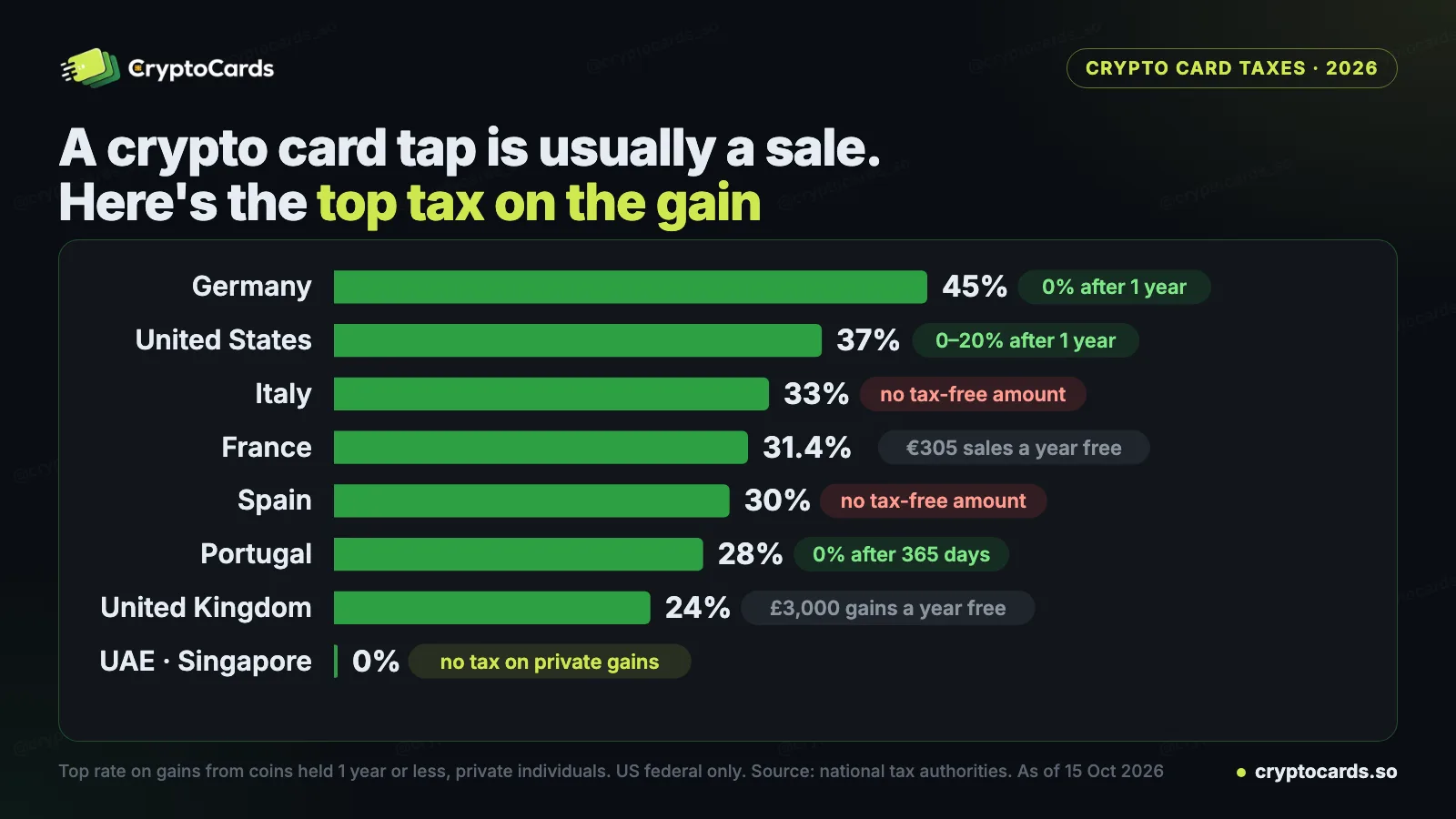
| Country | Is a card purchase taxed? | Tax on gains (2026) | Relief for small amounts or long holding | Cashback |
|---|---|---|---|---|
| United States | Yes | 10–37% if held 1 year or less, 0/15/20% if longer | None | Usually a discount (no official rule) |
| United Kingdom | Yes | 18% or 24% | £3,000 tax-free gains per year | Not taxed when received, taxed when sold |
| Canada | Yes | Half the gain is added to your income | None | Unclear, advisers disagree |
| Australia | Yes | Added to your income; 50% discount if held 12+ months | Personal-use exemption rarely applies to cards | Likely a discount (no official rule) |
| Germany | Only if held 1 year or less | Your income tax rate (0–45%) | Tax-free after 1 year; gains under €1,000 a year tax-free | Likely a discount, with a cost of €0 |
| France | Yes | 31.4% flat tax | Tax-free if total sales are €305 a year or less | No official rule |
| Spain | Yes | 19–30% | None | No official rule, advisers disagree |
| Italy | Yes | 33% (26% for qualifying euro e-money tokens) | None | No official rule |
| Portugal | Only if held under 365 days | 28% | Tax-free after 365 days | No official rule |
| Netherlands | No, not per purchase | Yearly tax on your holdings (Box 3) | €59,357 tax-free allowance | Counted with your holdings |
| Switzerland | No, for private investors | No tax on private gains, wealth tax on holdings | Not needed | Unclear |
| UAE | No | No personal income tax | Not needed | Not taxed |
| Singapore | No, unless you trade as a business | No capital gains tax | Not needed | Likely not taxed |
United States
Every card purchase is a sale of crypto. The gain is the purchase amount minus what you paid for the coins used. Stablecoins are treated like any other crypto.
Rates for 2026: coins held one year or less are taxed at your normal income tax rate (10–37%). Coins held longer are taxed at 0%, 15% or 20%. The 0% rate applies up to $49,450 of taxable income for single filers.
There's no small-purchase exemption. You may have read about a $200 or $300 de minimis rule. Those were proposals and none of them became law. A bill that passed the House Ways and Means Committee in September 2026 (H.R. 10357) would treat qualifying dollar stablecoins as having no gain or loss from 2027, but it isn't law yet.
Form 1099-DA: brokers report your gross sales from 2025, and your cost basis only for coins bought from 2026 in the same account. Card processors only report your sales if they total more than $600 a year. These are reporting limits, not tax exemptions: you owe tax either way.
United Kingdom
Paying with crypto is a disposal for Capital Gains Tax.
Rates for 2026/27: 18% within the basic-rate band and 24% above it. The first £3,000 of gains each year is tax-free.
Stablecoins are taxed like other crypto for now, and non-sterling ones can make small gains from exchange rates. HMRC published draft rules in July 2026, and updated them with the 28 October Budget, that would exempt "eligible stablecoins" from Capital Gains Tax from April 2027. They still have to pass Parliament in the next Finance Bill, so they aren't law yet.
Cashback: HMRC's long-standing practice is that ordinary shoppers aren't taxed on cashback. You can still owe tax when you sell the crypto later.
Reporting: crypto companies have collected data on UK users since 1 January 2026. You must give your provider your National Insurance number or UTR, or face a penalty of up to £300.
Canada
Using crypto to pay for goods is a disposal, treated like a barter.
Half of your gain is added to your income and taxed at your normal rate. The plan to raise that share to two-thirds was cancelled in 2025.
There's no exemption for small amounts. Values are counted in Canadian dollars, so US-dollar stablecoins can create small gains or losses.
Cashback has no official rule and advisers disagree on whether it's income.
Australia
Paying with crypto, and even topping up a card with crypto, is a CGT event.
Gains are added to your income. If you held the coins for at least 12 months, only half the gain is taxed. A law passed in June 2026 changes how capital gains are taxed from 1 July 2027. It doesn't affect the current tax year.
The personal-use asset exemption rarely helps card users. It covers crypto bought for under A$10,000 mainly to buy things for yourself. But the ATO says it usually doesn't apply when you top up a card that converts crypto to dollars.
Cashback: no ATO rule. It's most likely treated as a rebate.
Germany
Spending is only taxable if you held the coins for one year or less. Older coins are tax-free.
Every swap restarts the clock. If you swap Bitcoin for USDC, the USDC starts a new one-year period. Spending it within the year is taxable.
Gains under €1,000 a year are tax-free, but it's a cliff. At €1,000 or more, the whole amount is taxed, not just the part above €1,000.
Rates: your normal income tax rate, up to 45% plus solidarity surcharge.
Watch this: a draft from the finance ministry (September 2026) would end the one-year exemption for crypto bought from 2027. It's only a draft: the cabinet hasn't approved it yet.
Cashback: no official rule. Tax advisers mostly see it as a discount with a cost of €0, so selling it within a year is fully taxable.
France
Paying for goods or services with crypto is taxable. Swapping one crypto for another is not.
Rate: a 31.4% flat tax (12.8% income tax plus 18.6% social charges after the 2026 increase). You can choose the normal income tax scale instead.
The €305 rule is about total sales, not gains. If your crypto sales add up to €305 or less in a year, you pay nothing. Every card purchase counts toward that €305.
The trap: France calculates your gain based on your whole crypto portfolio. Spending €100 of USDC can create a taxable gain if your portfolio as a whole is in profit.
Watch this: in October 2026 the National Assembly voted for a budget amendment that would tax swaps into e-money stablecoins like USDC and EURC from 2027. The Senate still has to vote on the budget, so it's not law yet.
Spain
Spending crypto is taxable, and so are swaps between cryptos. That includes swapping into a stablecoin.
Rates (savings income): 19% up to €6,000, 21% up to €50,000, 23% up to €200,000, 27% up to €300,000 and 30% above that.
There's no tax-free amount for gains. If you hold more than €50,000 in crypto abroad on 31 December, you also have to file Form 721.
Cashback: no official rule, and advisers disagree on whether it's income.
Italy
Paying with crypto is a taxable sale. The finance ministry confirmed this in 2025.
Rate: 33% from 2026, up from 26%. The €2,000 tax-free amount was abolished from 2025, so gains are taxed from the first euro.
Euro stablecoins can be cheaper. Gains on qualifying euro e-money tokens are taxed at 26%, and converting euros into them at par isn't taxed. USDC and USDT stay at 33%.
Cashback: no official rule.
Portugal
Spending is taxable only if you held the coins for less than 365 days. Swaps between cryptos aren't taxed.
Rate: 28% flat on short-term gains.
Coins held 365 days or more are tax-free, but you still report them. There's a catch: the exemption can be lost if the company paying you is in a country Portugal has no tax agreement with. That's worth checking if your card is run from offshore.
Cashback: no official rule.
Netherlands
There's no tax on each purchase. Crypto is taxed once a year in Box 3, based on what you hold on 1 January.
2026: a deemed return of 6.00% on investments, taxed at 36%, above a tax-free allowance of €59,357 per person. You can report your actual return if it was lower.
Cashback simply becomes part of your holdings.
Switzerland
Private investors don't pay tax on crypto gains, including when they spend crypto. It's different if the tax office sees you as a professional trader.
You do pay wealth tax on your holdings, based on their value at the end of the year.
Don't assume everything is tax-free. Airdrops, staking and mining are taxed as income, which makes the treatment of cashback unclear. Ask your cantonal tax office.
UAE
No personal income tax, so spending crypto and receiving cashback aren't taxed for individuals.
The 9% corporate tax only reaches individuals running a business with more than AED 1 million in yearly turnover.
Singapore
No capital gains tax, so spending crypto isn't taxed for normal individuals. Gains are only taxed if you're trading as a business.
Cashback is likely not taxable: IRAS doesn't tax free tokens you receive without doing anything in return.
New in 2026: your crypto activity gets reported
Tax authorities are getting much better data on crypto, including card spending.
| Where | Who reports | Data collected from | First data shared |
|---|---|---|---|
| European Union (DAC8) | Crypto companies serving EU users | 1 January 2026 | By 30 September 2027 |
| United Kingdom (CARF) | Crypto companies serving UK users | 1 January 2026 | First reports due May 2027 |
| United States (Form 1099-DA) | Brokers and card processors | Sales from 2025 | Forms sent from early 2026 |
| Canada, Australia, Singapore, Switzerland, UAE (CARF) | Crypto companies | 2027 (planned) | 2028 |
Under DAC8, card spending will most likely show up as sales of crypto for euros, which are reported whatever the amount. A few countries, including Spain, are late putting DAC8 into national law, but that doesn't change what you owe.
How to keep it simple
Spend stablecoins, not Bitcoin or Ether, if you want fewer taxable gains. In most countries this keeps each gain close to zero.
Download your card's transaction history regularly. Card apps don't always keep it forever, and Germany expects you to keep records from foreign platforms.
Know your holding-period rules. In Germany and Portugal, waiting past one year can make spending tax-free.
Track your cashback. Note what you received and when, especially if it's paid in a token.
Don't confuse reporting limits with tax exemptions. A company not reporting a small sale doesn't make it tax-free.
Use software that imports your card transactions instead of building a spreadsheet by hand.
Tools that do this for you
Crypto tax software imports your transactions, matches each sale to the coins you used, and produces the forms your tax office asks for. Most let you import for free and charge when you download a report, usually starting around $50 a year.
| Tool | Best for | Free to start? | Good to know |
|---|---|---|---|
| Koinly | Most countries | Yes, pay for reports | Reports for 100+ countries, local forms for 20+ |
| CoinTracker | US filers | Yes, with limits | Works with TurboTax and H&R Block |
| CoinLedger | US filers | Yes, pay for reports | Exports to TurboTax and TaxAct |
| Summ | 20+ countries, strong in Australia | Yes, pay for reports | Formerly Crypto Tax Calculator; powers MetaMask's tax hub |
| Blockpit | Germany, Austria, Switzerland | Free tracking, pay per report | Pre-filled local tax forms |
Before you pick one, check that it supports your country's tax forms and can import the history from your card or wallet.
Looking for a card that makes this easier? Compare stablecoin cards or see all cards on CryptoCards.so.
How we made this post
Sources: official tax authority pages for each country (listed at the end of this post), our database of 129 reviewed cards, and onchain card data from Paymentscan. Rules are as of 15 October 2026, and we mark proposals that aren't law yet. We rechecked those proposals on 2 November 2026.
AI and editing: we use AI tools to help research and draft. An editor checks every fact, number and source before we publish or update a post.
Mistakes: if you spot one, tell us and we'll fix it.
More in how we write our blog posts.
FAQ
Is paying with a crypto card taxable?
In most countries, yes. The card sells your crypto to pay the shop, and that sale counts as a disposal. You owe tax on any gain since you bought the coins. The UAE, Singapore and Switzerland don't tax private gains, and Germany and Portugal don't tax coins held longer than a year.
Do I pay tax when I spend stablecoins?
Usually very little. Because a stablecoin holds its value, the gain is close to zero. But in most countries each spend is still a sale on paper, and if your tax currency is different from the coin's (for example euros vs. a dollar stablecoin), small gains or losses can appear.
Is crypto cashback taxable?
There are almost no official rules. Most advisers treat cashback from your own spending as a discount, not income. You can still owe tax when you sell the cashback later, if it went up in value.
Do I have to report every crypto card purchase?
In countries that tax each disposal, like the US, UK, Canada, Australia, France, Spain and Italy, every purchase counts. In practice, tax software groups them for you. Some countries have thresholds, such as the UK's £3,000 allowance and France's €305 sales limit.
Which countries don't tax crypto spending?
For private individuals: the UAE, Singapore and Switzerland. The Netherlands doesn't tax each purchase but taxes your holdings once a year. Germany and Portugal don't tax coins held longer than one year.
Will my crypto card company report me to the tax office?
Increasingly, yes. EU and UK crypto companies collect data from 2026, and US brokers send Form 1099-DA. Canada, Australia, Singapore, Switzerland and the UAE plan to start in 2027.
Keep reading
Stablecoins
Best Crypto Wallets for Stablecoins in 2026, and Which Ones Come With a Card
10 min read
Market Data
Crypto Card Statistics 2026: Monthly Spend, Market Share and the Fastest-Growing Cards
9 min read
Stablecoins
Stablecoin Cards Explained: How to Spend USDC and USDT Anywhere Visa Works
9 min read