Stablecoin Cards Explained: How to Spend USDC and USDT Anywhere Visa Works
What a stablecoin card is, how paying with USDC or USDT on Visa works, what it really costs and how to pick one. With real spend data and fees from 129 cards.

9 min read
We may earn a commission when you sign up through links on this page. It never affects how we rate cards. How we rate
Key takeaways
- A stablecoin card is a Visa or Mastercard debit card funded with USDC or USDT. The shop gets paid in its own currency and never touches crypto.
- 71% of the 129 cards we review accept USDT and 64% accept USDC. 69 cards take both.
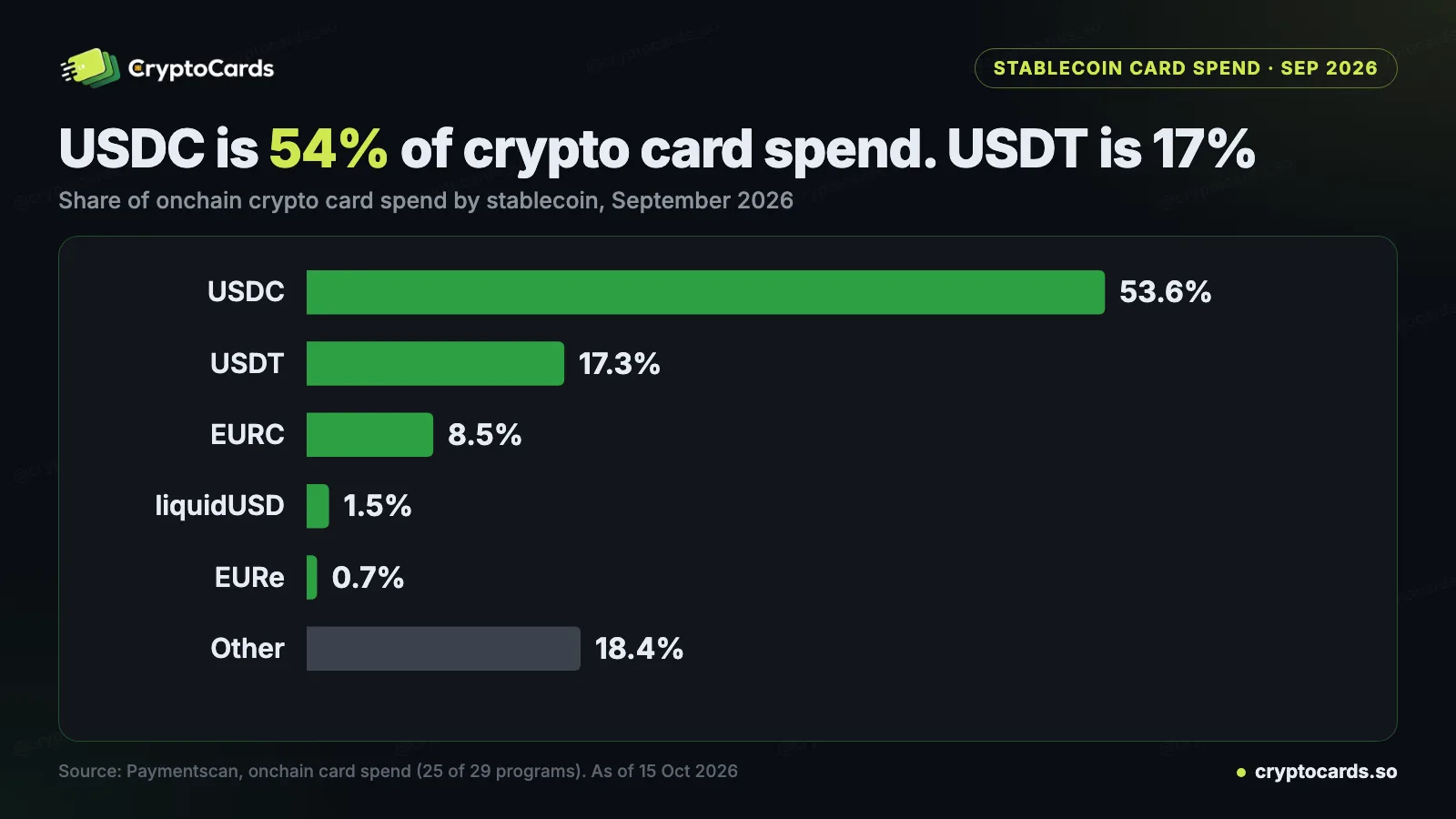
- USDC is 54% of onchain crypto card spend. USDT is 17%.
- Most stablecoin cards are free to hold. Typical fees are about 0.75% to top up, 1% for foreign currency and 2% at ATMs.
- Always send on a chain your card supports. A deposit on the wrong chain can be lost.
- In the EU, USDT isn't authorized under MiCA, so USDC is usually the easier choice.
On this page
- What is a stablecoin card?
- How a payment works, step by step
- Custodial vs. self-custodial cards
- USDC or USDT: which should you spend?
- The blockchain you send on matters
- What it costs
- Where you can use it
- What to watch out for
- How to choose a stablecoin card
- The most-used stablecoin cards right now
- How we made this post
- FAQ
- Sources
A stablecoin card lets you spend USDC or USDT like normal money. You hold digital dollars, you tap a Visa card at a shop, and the shop gets paid in its own currency. It never touches crypto.
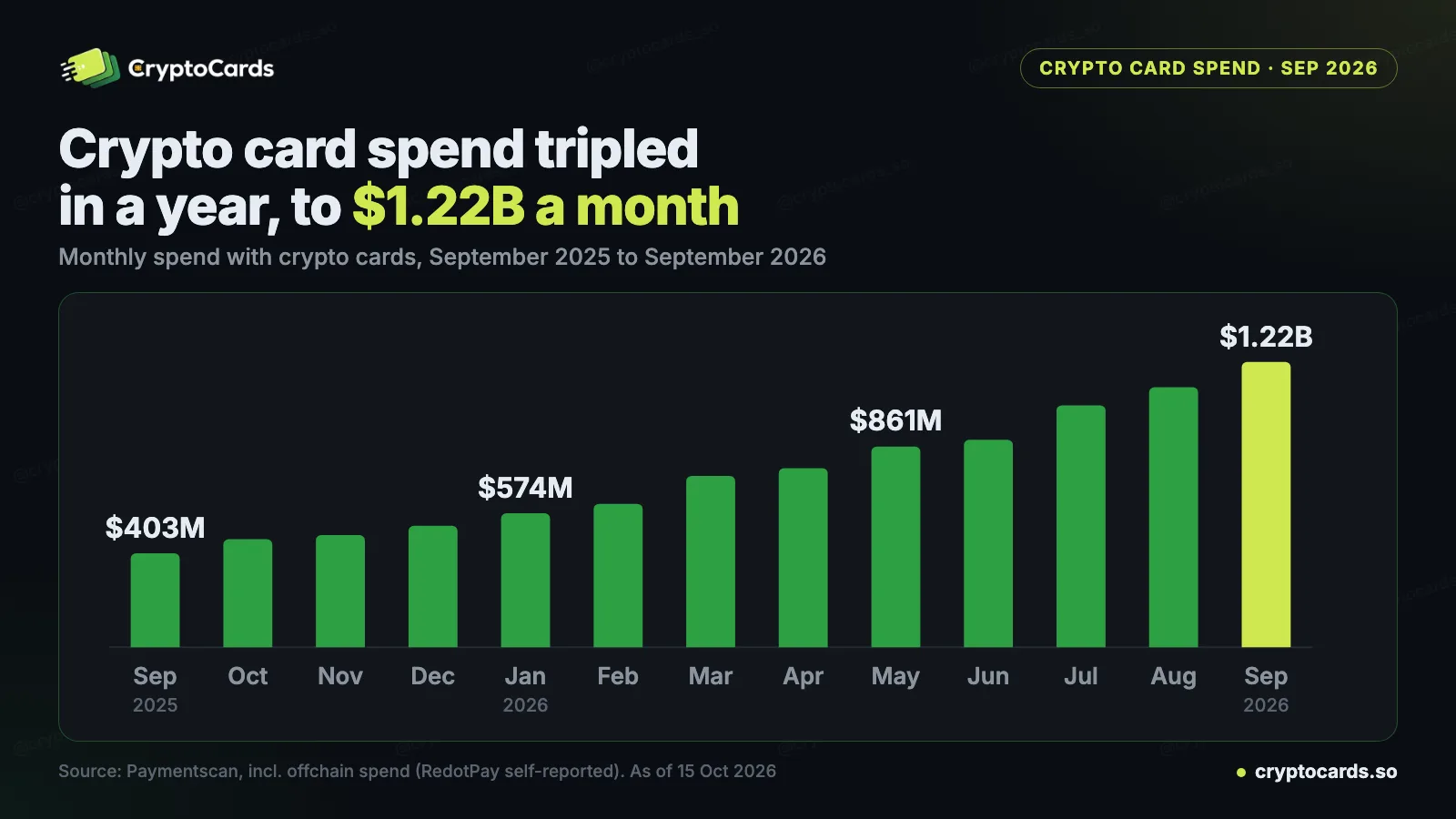
People spent $1.22 billion with crypto cards in September 2026, three times more than a year earlier. Visa says more than 160 stablecoin card programs now run on its network.
Below we explain how these cards work, what they actually cost, and what to watch out for. We use real data from the 129 cards we review and from onchain card payments.
What is a stablecoin card?
A stablecoin is a crypto token that's built to stay worth one unit of a normal currency. USDC and USDT are pegged to the US dollar, so 1 USDC is meant to be worth $1. EURC does the same for the euro.
A stablecoin card connects that balance to a regular payment card:
For you, it works like a debit card. You see a dollar balance in an app and you spend it.
For the shop, it's just another Visa or Mastercard payment. They get paid in their local currency and never deal with crypto.
For your budget, there are no price swings. $100 of USDC is still about $100 when you pay, which isn't true for a card that sells your Bitcoin at checkout.
That last point is why most crypto card spending now runs on stablecoins.
How a payment works, step by step
You add stablecoins. You send USDC or USDT to the card's wallet address, or you connect your own wallet, depending on the card.
You pay. Tap the card, use Apple Pay or Google Pay, or type the card number online.
The card checks your balance. In a fraction of a second the card company confirms you have enough and approves the payment.
The shop gets paid. The card company pays the merchant through Visa in the local currency. Your stablecoin balance goes down by the dollar amount, plus any fees.
The card company settles up with Visa. More and more of this happens in stablecoins too. Visa says its stablecoin settlement passed a $20 billion annual run rate in 2026.
You only see steps 1 and 2. Everything else happens in the time it takes the terminal to beep.
Custodial vs. self-custodial cards
This is the biggest difference between stablecoin cards, and it's worth deciding before anything else.
| Custodial | Self-custodial | |
|---|---|---|
| Who holds your money | The card company | You, in your own wallet |
| How you add money | Send stablecoins to an address the company gives you | Keep funds in your wallet, the card spends from it |
| If the company has problems | Your balance can be frozen or stuck | Your funds stay in your wallet |
| What it feels like | Like a fintech app, usually more coins and chains | More like using a crypto wallet |
| Examples | RedotPay, KAST | EtherFi, MetaMask |
Of the 129 cards we review, a little over half are self-custodial. Neither type is better for everyone. Custodial cards are usually easier to start with. Self-custodial cards mean you don't have to trust the company with your balance.
USDC or USDT: which should you spend?
| USDC | USDT | |
|---|---|---|
| Issued by | Circle | Tether |
| Share of onchain card spend, Sep 2026 | 53.6% | 17.3% |
| Cards on our site that accept it | 82 (64%) | 92 (71%) |
| In the EU | Authorized under MiCA | Not authorized under MiCA |
More cards accept USDT, but more of the actual spending happens in USDC. Keep in mind these spend shares are onchain only, so they leave out RedotPay, which reports its spend separately.
Which one to use depends on where you are and what you already hold:
You already hold USDT, maybe on Tron? Pick a card that accepts USDT on the chain you use. 34 of the cards we list support Tron.
You're in the EU? USDC is the easier choice. Tether isn't authorized under MiCA, and regulated EU platforms stopped offering USDT after the transition period ended on 1 July 2026. Check whether a card accepts USDT in your country before you pick it.
You mostly spend in euros? A card that takes EURC lets you skip the dollar-to-euro conversion. Support is still rare though: only 5 cards on our site list it.
69 of the cards we list accept both USDC and USDT, so you don't always have to choose.
The blockchain you send on matters
Stablecoins exist on many blockchains. When you add money to a card, you have to send it on a chain the card supports. If you send on a chain the card doesn't list, your money can be lost. Always check the deposit screen first.
| Chain | Cards on our site that accept deposits on it | Share of onchain card spend settled there, Sep 2026 |
|---|---|---|
| Ethereum | 75 | 6.2% |
| Solana | 43 | 13.9% |
| Polygon | 38 | 6.4% |
| Tron | 34 | not broken out |
| Arbitrum | 22 | 7.5% |
| Base | 17 | 27.5% |
| Optimism | 12 | 16.1% |
The two columns measure different things. The first is where you can send money in. The second is where the card companies settle payments behind the scenes. Base is a good example: only 17 cards let you deposit on it, but it settles more card spend than any other chain, because several big card programs settle there.
The practical tip: send on the cheapest chain your card supports. Fees change a lot. On 15 October 2026 a USDT transfer cost about 1 to 2 cents on Ethereum and a fraction of a cent on Solana, Base or Polygon, but about $2 to $4 on Tron unless you had staked energy.
What it costs
Typical fees across the 105 cards on our site that accept USDC or USDT:
| Fee | Typical (median) | Free on | Highest we've seen |
|---|---|---|---|
| Monthly fee | $0 | 75 of 91 | $299 |
| Card issuance | $0 | 47 of 91 | $450 |
| Top-up fee | 0.75% | 34 of 76 | 8% |
| FX fee (paying in another currency) | 1% | 20 of 62 | 3.9% |
| Conversion spread | 0.9% | 8 of 42 | 7.9% |
| ATM withdrawal | 2% | 3 of 30 | 3% |
"Free on" counts only the cards that publish that fee.
Most cards are free to hold. Where you pay is when money moves: adding funds, paying in a foreign currency, or taking out cash.
Example. You use a USD stablecoin card to pay for a €40 dinner in Lisbon. Say the exchange rate is $1.10 per euro (just for the example).
| Amount | |
|---|---|
| Dinner in dollars | $44.00 |
| 1% FX fee | $0.44 |
| 0.75% top-up fee on what you loaded | about $0.34 |
| Total cost | about $44.78 |
That's about 1.8% on top of the dinner's dollar price. Not bad, but it adds up if you travel a lot. If you spend mostly in one foreign currency, look for a card with a 0% FX fee or one that holds that currency, like EURC for euros.
Where you can use it
Anywhere that takes Visa or Mastercard. Together the two networks are accepted at more than 150 million merchant locations in over 200 countries and territories. That includes online shops and subscriptions.
With your phone. 77% of the cards we list work with Apple Pay, and 77% with Google Pay.
At ATMs, on some cards. Expect a fee, usually around 2%.
A few places can be tricky. Car rental companies and hotels sometimes refuse prepaid and debit cards for deposits. And most cards don't work in every country: 85% of the cards we list are marketed as available worldwide, but more than half of those still have a list of excluded countries.
What to watch out for
Custodial risk. With a custodial card, the company holds your money. If it freezes accounts or runs into trouble, your balance can get stuck.
Cards can shut down. Card programs come and go. Two programs tracked by Paymentscan, Ready and Solflare, have had no card spend since August 2026, and Gnosis Pay is closing its consumer card on 20 December 2026. Don't keep more on a card than you need to spend.
Wrong-chain deposits. Mentioned above, but it's the most common way people lose money with these cards.
Stablecoins can wobble. It's rare, but it happens. In March 2023, USDC briefly fell to about 88 cents when one of its banks failed. It recovered within days.
KYC. Most cards ask for ID. Only 22% of the cards we list don't require KYC, and those usually come with lower limits. See our no-KYC cards.
Taxes. In many countries, including the US and the UK, spending crypto counts as selling it, and that includes stablecoins. Because a stablecoin holds its value, the gain is usually close to zero, but you may still need to report it. Check the rules where you live.
How to choose a stablecoin card
Go through these in order:
Is it available where you live? Check the excluded countries first. Nothing else matters if you can't get it.
Does it take the stablecoin you have, on the chain you use?
Custodial or self-custodial? Decide who you want holding your money.
Fees for how you'll use it. If you travel, the FX fee matters most. If you need cash, check ATM fees.
Real cashback, not advertised cashback. In our data, cards that advertise up to 4% or 8% actually paid out 0.9% to 2.4% of spend. See the cashback section of our statistics page.
Apple Pay or Google Pay, if you want to pay with your phone.
The most-used stablecoin cards right now
By card spend in September 2026:
| Card | Spend, Sep 2026 | Good to know |
|---|---|---|
| RedotPay | $403.2M* | The biggest by far. Custodial. |
| EtherFi | $128.8M | Self-custodial. 3% cashback from the entry tier. |
| KAST | $113.8M | Custodial. Deposits on 7 chains, including Tron and Solana. |
| Wirex One | $47.6M | Cashback from 0.5% to 8% depending on tier. |
| Plasma One | $25.6M | Built on Plasma's own chain. 2% to 4% cashback by tier. |
| Gnosis Pay | $7.6M | Closing its consumer card on 20 December 2026. |
| MetaMask | $2.5M | Self-custodial. Spends straight from your MetaMask wallet. |
* RedotPay's spend is self-reported. The rest is read onchain by Paymentscan.
For the full rankings and how they're changing month to month, see our crypto card statistics.
How we made this post
Sources: onchain card data from Paymentscan, our database of 129 reviewed cards, and official pages from Visa, Circle and the card companies. All sources are listed at the end of this post.
AI and editing: we use AI tools to help research and draft. An editor checks every fact, number and source before we publish or update a post.
Mistakes: if you spot one, tell us and we'll fix it.
More in how we write our blog posts.
FAQ
What is a stablecoin card?
A Visa or Mastercard debit card that you fund with stablecoins like USDC or USDT. When you pay, the card company converts your stablecoins and pays the shop in its local currency.
Can I spend USDT with a Visa card?
Yes. 71% of the cards we list accept USDT. You send USDT to the card, and the card pays in local currency anywhere Visa is accepted. In the EU, check that the card supports USDT in your country first.
Is USDC or USDT better for a crypto card?
Both work. USDC is spent more (54% of onchain card spend vs. 17% for USDT) and is authorized under MiCA in the EU. USDT is accepted by slightly more cards and is common on Tron. Use the one you already hold, on a chain your card supports.
Do stablecoin cards charge fees?
Usually not to hold one: most have no monthly fee. You mainly pay when money moves. Typical fees are about 0.75% to add funds, 1% for foreign currency payments and 2% for ATM withdrawals.
Do I need KYC for a stablecoin card?
For most cards, yes. Only about one in five of the cards we list works without KYC, usually with lower limits.
Can I use a stablecoin card abroad?
Yes, anywhere that takes Visa or Mastercard. Just check the card's excluded countries, and expect an FX fee of around 1% when you pay in a different currency.
Ready to pick one? See all cards that accept USDT or USDC on CryptoCards.so, and filter by your country, fees and KYC.
Sources
Crypto card spend: CryptoCards.so crypto card statistics
Visa stablecoin card programs and settlement: The Block
Spend by stablecoin: Paymentscan
Spend by settlement chain: Paymentscan
USDC under MiCA: Circle
USDT in the EU after MiCA: The Paypers
Card acceptance: Nilson Report
Network fees: Etherscan gas tracker, Solana fees, Tron resource model
Card programs that stopped: Ready, Solflare, Gnosis Pay closure notice
USDC in March 2023: Circle
Card counts, fees and features: CryptoCards.so database of 129 reviewed cards, 15 October 2026