Best Crypto Wallets for Stablecoins in 2026, and Which Ones Come With a Card
The best self-custodial wallets for holding, sending and spending USDC and USDT in 2026, compared on chains, fees and safety, plus which ones have a card and how much it is really used.

11 min read
We may earn a commission when you sign up through links on this page. It never affects how we rate cards. How we rate
Key takeaways
- Best all-rounder for stablecoins: MetaMask. It supports Ethereum, Base, Solana and Tron, lets you pay network fees in USDC or USDT on several chains, and its card spends straight from your wallet in Europe, Canada and Latin America.
- Best for USDT on Tron: Trust Wallet or Bitget Wallet. Half of all USDT sits on Tron, and both handle it well.
- Best for Solana and US card users: Phantom. Easy USDC and its own CASH stablecoin, with a free virtual Visa card in the US.
- Best for sending money to friends: Exodus. Exodus Pay lets you send stablecoins to a phone number.
- Best hardware wallet: Ledger for the widest support, Trezor if you don't want a card, Tangem if you want a card and a cheap, simple device.
- Best if the card matters most: a card-first app like ether.fi Cash. In our data, people spend far more with these than with cards added to big wallets.
There's now about $307 billion in stablecoins, and most of it is USDT ($184B) and USDC ($73B), according to DefiLlama. If that's the money you hold, the wallet you pick decides three things: which blockchains you can use, how much you pay to move it, and whether you can spend it with a card.
We compared 11 popular wallets on exactly that. We also used onchain card data to see which wallet cards people actually use.
Why the wallet matters for stablecoins
The blockchain matters more than the coin. USDT and USDC exist on many chains, and a wallet only helps if it supports the one your money is on.
| Where most of it is | |
|---|---|
| USDT ($184B) | Tron 51%, Ethereum about 40%, BNB Chain 5% |
| USDC ($73B) | Ethereum about two-thirds, then Solana, Hyperliquid and Base |
So if you get paid in USDT, you almost certainly need Tron support. Phantom, Coinbase Wallet and Rabby don't have it.
Network fees changed a lot. The old advice was "use Tron, it's cheap". On 15 October 2026 it was the other way around:
| Sending USDT on... | Network fee (15 Oct 2026) |
|---|---|
| Ethereum | about 1–2 cents |
| Solana | a fraction of a cent |
| Tron, without staked energy | about $2–4 |
Fees on Ethereum can spike when the network is busy, and some wallets cover Tron fees for you. But it's worth checking before you assume one chain is always cheapest.
Paying gas in stablecoins is a big quality-of-life upgrade. Normally you need a bit of ETH, SOL or TRX just to move your USDC. Several wallets now take the fee in the stablecoin itself. "Gasless" usually means the fee is taken in another token, not that it's free.
The wallets compared
| Wallet | Type | USDT on Tron | Pay fees in stablecoins | Card | Card available in |
|---|---|---|---|---|---|
| MetaMask | Software | Yes | Yes, on several EVM chains | MetaMask Card, spends from your wallet | EU/EEA, Switzerland, Canada, Latin America |
| Phantom | Software | No | Yes, on Solana | Phantom debit card (virtual Visa) | US only |
| Trust Wallet | Software | Yes | Yes (FlexGas) | No official card | |
| Bitget Wallet | Software | Yes | Yes (GetGas) | Bitget Wallet Card, top-up | EEA, UK, Latin America, Asia-Pacific; not the US |
| Coinbase Wallet | Software | No | Limited | No (Coinbase Card is for the exchange) | |
| Exodus | Software | Yes, but not in Exodus Pay | Free sends within Exodus Pay | Exodus Card (virtual) | US, Canada, EU/EEA, Latin America; not the UK |
| SafePal | Software + hardware | Yes | Not that we found | SafePal card via Fiat24, top-up | About 40 countries incl. EU and UK; not the US |
| Rabby | Software, EVM only | No | Yes (Gas Account) | No | |
| Ledger | Hardware | Yes | CL Card, top-up | UK, EEA, US (not NY or VT) | |
| Trezor | Hardware | Yes | No | ||
| Tangem | Hardware | Yes | Tangem Pay (Visa) | US, Latin America, Asia-Pacific, Middle East and Africa |
"Top-up" means you move money from your wallet onto the card's balance. Once it's there, it's no longer in your self-custody.
Wallet cards: how much they're actually used
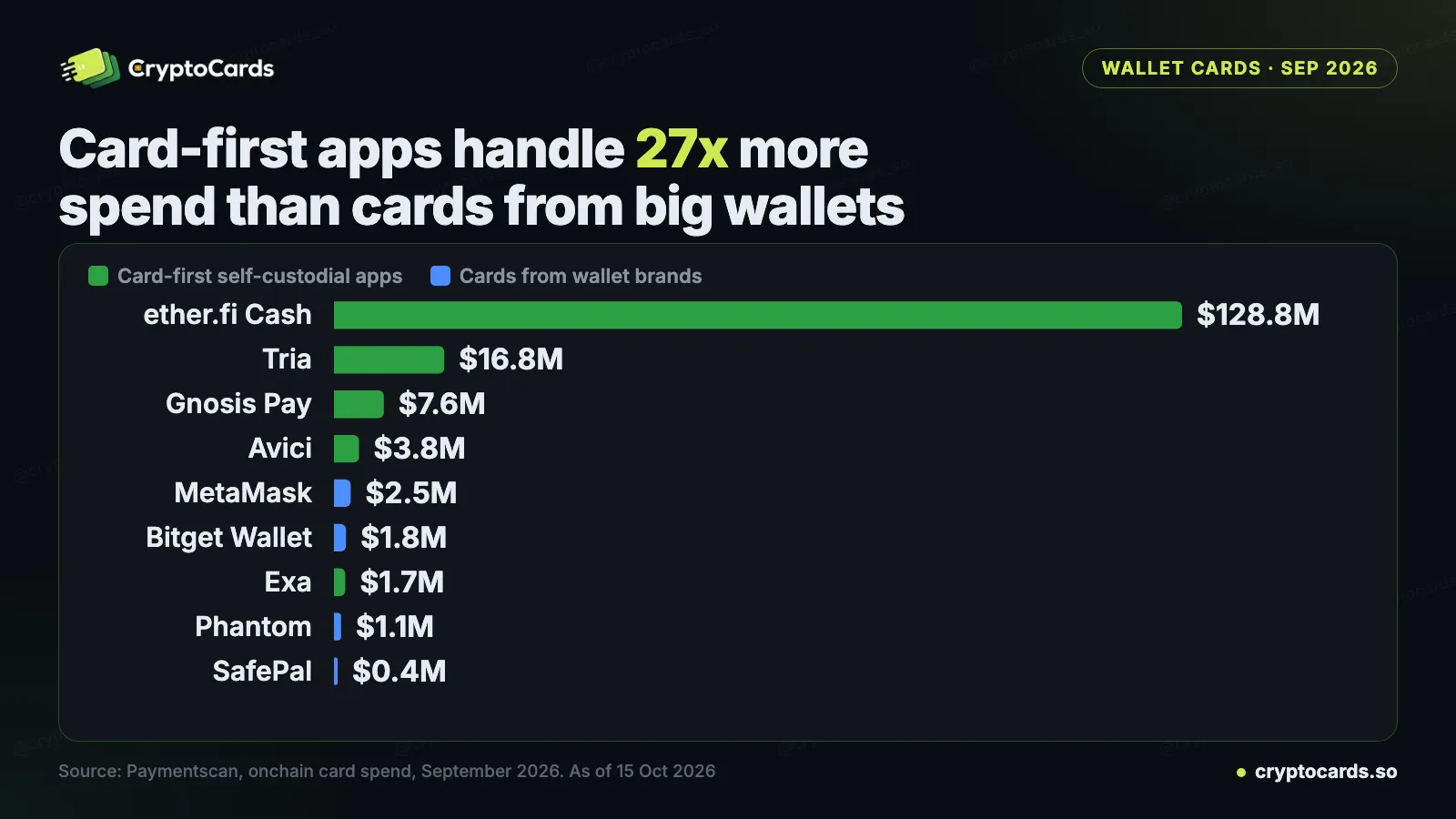
Using onchain card data from Paymentscan, here's how much people spent in September 2026 with cards attached to well-known wallets, and with "card-first" apps built around spending.
Cards from big wallet brands
| Card | Spend, Sep 2026 | Trend |
|---|---|---|
| MetaMask Card | $2.54M | down 48% on a year earlier |
| Bitget Wallet Card | $1.82M | down from $5.2M in June |
| Phantom card | $1.09M | flat since June |
| SafePal card | $0.42M | down from $2.69M in June |
| Solflare card | $0 | no spending since August |
| Ready card | $0 | no spending since August |
Card-first self-custodial apps
| Card | Spend, Sep 2026 | Good to know |
|---|---|---|
| ether.fi Cash | $128.8M | The biggest by far. Up to 3% cashback, paid in ETHFI |
| Tria | $16.8M | Cashback from 1.5% to 6% by plan |
| Gnosis Pay | $7.6M | Consumer card closes on 20 December 2026 |
| Avici | $3.8M | Secured credit card; not in the EU or UK |
| Exa | $1.7M | Pay now or in installments; not in the EU or UK |
The four big wallet brands' cards added up to about $5.9M in September. The five card-first apps did about $159M, roughly 27 times more.

Ether.fi
Ether.fi Cash Card- Monthly fee
- Free
- Card fee
- $40.00
- FX fee
- 1%
- Cashback
- Up to 4%
- KYC
- ID verification
What it means for you: if the card is the main reason you're choosing a wallet, a card-first app usually gives you more. If you want the best place to hold and move stablecoins, pick the wallet first and treat the card as a bonus. And pick a card that's growing: two wallet cards in this table stopped being used this year, and Gnosis Pay is closing its consumer card.
The best wallets for stablecoins, one by one
MetaMask
Why it's good for stablecoins: supports Ethereum and other EVM chains, Solana and, since January 2026, Tron. You can pay network fees in USDC or USDT on several chains, and it has its own dollar stablecoin, mUSD.
Card: the MetaMask Card is a Mastercard that spends straight from your wallet, so your money stays in your custody until you pay. The virtual card is free, with 1% cashback in mUSD. Paying in your home currency's stablecoin has no fee; a different-currency stablecoin costs 0.5%, and the virtual card adds 1% on cross-border purchases.
Watch out: new card sign-ups in the US and UK are closed for now. Swaps cost 0.875%.

MetaMask
MetaMask Card- Monthly fee
- Free
- Card fee
- Free
- FX fee
- 0%
- Cashback
- Up to 3%
- KYC
- ID verification
Phantom
Why it's good for stablecoins: the easiest wallet for USDC on Solana. Sends and swaps on Solana are gasless (the fee comes out of the token you're using), and you can send to a Phantom username. Its own stablecoin, CASH, sits in a separate Cash account, and swapping major stablecoins into CASH is free.
Card: a free virtual Visa debit card that spends your CASH. US only (not New York), and no cashback.
Watch out: no Tron, and supported chains change often. Phantom dropped Sui and Monad in 2026. Most swaps cost 0.85%.
Trust Wallet
Why it's good for stablecoins: 100+ chains including Tron, and FlexGas lets you pay fees in USDT or USDC on several chains. Same-chain stablecoin swaps are currently free on most networks except Ethereum.
Card: none. Trust Wallet has no official card, so sites selling a "Trust Wallet Card" aren't from Trust Wallet.
Watch out: in December 2025 a compromised version of the browser extension drained about 2,500 wallets, with roughly $8.5 million affected by Trust Wallet's own count. The mobile app wasn't affected, and Trust Wallet is reimbursing affected users.
Bitget Wallet
Why it's good for stablecoins: strong Tron support, and GetGas lets you prepay network fees in USDT or USDC across EVM chains, Solana and Tron. You can also pay by QR code with stablecoins in some countries, like Vietnam, the Philippines and Brazil.
Card: the Bitget Wallet Card works in 50+ markets, with a physical card since April 2026. You top it up with USDT or USDC. Not available in the US.
Watch out: card fees and network vary by region. The September 2026 hack hit the Bitget exchange, not the wallet.
Coinbase Wallet
Why it's good for stablecoins: built around USDC on Base, with easy sending by link or QR code and a smooth way to buy through Coinbase. It was briefly called "Base app" and got its old name back in September 2026.
Card: none for the wallet. The Coinbase Card belongs to the Coinbase exchange account, not the self-custodial wallet.
Watch out: no Tron, and swaps cost up to 1%.
Exodus
Why it's good for stablecoins: Exodus Pay lets you send stablecoins to a phone number or contact for free, and its balance holds Exodus's own XO Cash plus USDC and USDT on Solana.
Card: a free virtual Exodus Card that spends your Solana stablecoins. Available in the US, Canada, most of Europe and Latin America, but not the UK.
Watch out: the main wallet supports USDT on Tron, but Exodus Pay doesn't accept Tron deposits. Exodus has said its European card growth depends on fixing its card issuing setup.
SafePal
Why it's good for stablecoins: works on 100+ chains including Tron, and pairs with SafePal's cheap hardware wallets.
Card: a virtual Mastercard linked to a Swiss account run by Fiat24. You top it up, so it's not self-custodial while the money sits there. Not available in the US.
Watch out: an August 2026 breach exposed order data (names, addresses, phone numbers) for about 40,000 customers. No keys were exposed, but expect phishing attempts.
Rabby
Why it's good for stablecoins: the best choice if you use DeFi on EVM chains. Its Gas Account pays fees on any supported chain from a USDC or USDT balance, it simulates transactions before you sign, and swaps cost 0.25%.
Card: none.
Watch out: EVM only, so no Solana or Tron.
Hardware wallets for stablecoins
If you hold a lot in stablecoins, a hardware wallet keeps your keys offline. All three below handle USDT on Tron.
| Ledger | Trezor | Tangem | |
|---|---|---|---|
| Starting price | $69 (Nano S Plus) | $59 (Safe 3) | $54.90 (2-card set) |
| Other models | Nano X $99, Nano Gen5 $179, Flex $249, Stax $399 | Safe 5 $129, Safe 7 $249 | 3-card set $69.90, Ring $160 |
| App | Ledger Wallet | Trezor Suite | Tangem app |
| Card | CL Card (top-up) | None | Tangem Pay (Visa) |
Ledger: the widest support. The CL Card costs nothing to get but charges 2% on card spending from crypto balances, and money leaves your self-custody once you top it up. Customer names and addresses leaked through an e-commerce partner in January 2026, so watch for phishing. Prices are from the official stores on 15 October 2026.
Trezor: fully open-source and no card. The Safe 7, launched in October 2025, adds Bluetooth and wireless charging. Good if you just want to hold.
Tangem: card-shaped devices with no seed phrase by default. Tangem Pay is a Visa card with a free basic plan, 1% cashback in USDC on purchases over $30, and a 1.5% FX fee. A physical card launched in October 2026. It's available in the US, Latin America, Asia-Pacific, the Middle East and Africa; Europe and the UK aren't confirmed yet.

Tangem
Tangem Pay- Monthly fee
- Free
- Card fee
- Free
- FX fee
- —
- Cashback
- —
- KYC
- ID verification
How to choose
Which chain is your money on? If it's USDT on Tron, rule out Phantom, Coinbase Wallet and Rabby.
Do you want to pay fees in stablecoins? MetaMask, Trust Wallet, Bitget Wallet and Rabby can.
Do you need a card, and where do you live? Card availability is the most common dealbreaker. Check the country list first.
Spend-from-wallet or top-up? MetaMask's card spends from your wallet. Most others need a top-up, which takes the money out of your custody.
How much are you holding? Above a few thousand dollars, add a hardware wallet.
Keep your stablecoins safe
Never type your recovery phrase into a website or share it with "support". No real wallet will ask for it.
Check the network before you send. Sending USDT on the wrong chain is the most common way people lose stablecoins.
Copy addresses from your contacts, not your transaction history. Scammers send tiny amounts from look-alike addresses so you copy the wrong one.
Revoke old token approvals from time to time. Rabby and other tools show you which apps can still move your tokens.
Don't keep more on a top-up card than you plan to spend. Card programs can close, as Gnosis Pay's consumer card is about to.
How we made this post
Sources: each wallet's official site and help center, onchain card data from Paymentscan, stablecoin supply from DefiLlama, and our database of 129 reviewed cards. All sources are listed at the end of this post. Prices and fees are as of 15 October 2026.
AI and editing: we use AI tools to help research and draft. An editor checks every fact, number and source before we publish or update a post.
Mistakes: if you spot one, tell us and we'll fix it.
More in how we write our blog posts.
FAQ
What is the best wallet for stablecoins?
For most people, MetaMask: it supports the main stablecoin chains including Tron, lets you pay fees in USDC or USDT, and has a card that spends straight from your wallet. If you mainly use Solana, Phantom is easier. For large amounts, add a hardware wallet like Ledger or Trezor.
What's the best wallet for USDT on Tron?
Trust Wallet and Bitget Wallet are the strongest for Tron, and MetaMask has supported it since January 2026. Phantom, Coinbase Wallet and Rabby don't support Tron at all.
Which crypto wallets come with a debit card?
MetaMask, Phantom, Bitget Wallet, Exodus, SafePal, Ledger and Tangem all offer cards in 2026, each in different countries. Trust Wallet, Coinbase Wallet, Rabby and Trezor don't have one for their self-custodial wallet.
Is a wallet card self-custodial?
Only some are. The MetaMask Card spends directly from your wallet, so you keep custody until you pay. Most others, including Bitget Wallet, SafePal and Ledger's CL Card, need a top-up, and the topped-up money isn't in your self-custody anymore.
Are hardware wallets good for stablecoins?
Yes, especially for larger amounts. Ledger, Trezor and Tangem all support USDT and USDC, including USDT on Tron. For daily spending, pair one with a card or keep a smaller balance in a software wallet.
What's the cheapest way to send USDT?
It depends on the day. On 15 October 2026 an Ethereum transfer cost about 1–2 cents, Solana a fraction of a cent, and Tron about $2–4 unless you had staked energy. Some wallets, like Bitget Wallet, cover part of the Tron fee for you.
Want a card for your stablecoins? Read our post on stablecoin cards or compare all cards on CryptoCards.so.
Sources
Stablecoin supply and where it sits: DefiLlama, 15 October 2026
Network fees: Etherscan gas tracker, Solana fees, Tron resource model
Card spend: Paymentscan card pages, for example MetaMask and Phantom
MetaMask: MetaMask Card, card fees, paying fees in stablecoins
Phantom: Phantom debit card, supported networks
Trust Wallet: 0% stablecoin swaps, extension incident update
Bitget Wallet: Bitget Wallet Card
Coinbase Wallet: supported networks
Exodus: Exodus Pay
Rabby: rabby.io
Ledger: CL Card, Nano Gen5 and Ledger Wallet
Trezor: Safe 7
Tangem: Tangem Pay, Tangem Pay fees
Card-first apps: ether.fi, Tria, Avici, Exa, Gnosis Pay closure notice
Cards in this article