Crypto Card Statistics 2026: Monthly Spend, Market Share and the Fastest-Growing Cards
Crypto card spend hit $1.22B in September 2026, 3x a year earlier. Monthly totals, top cards, market share, stablecoins, chains and real cashback. Updated monthly.

9 min read
We may earn a commission when you sign up through links on this page. It never affects how we rate cards. How we rate
Key takeaways
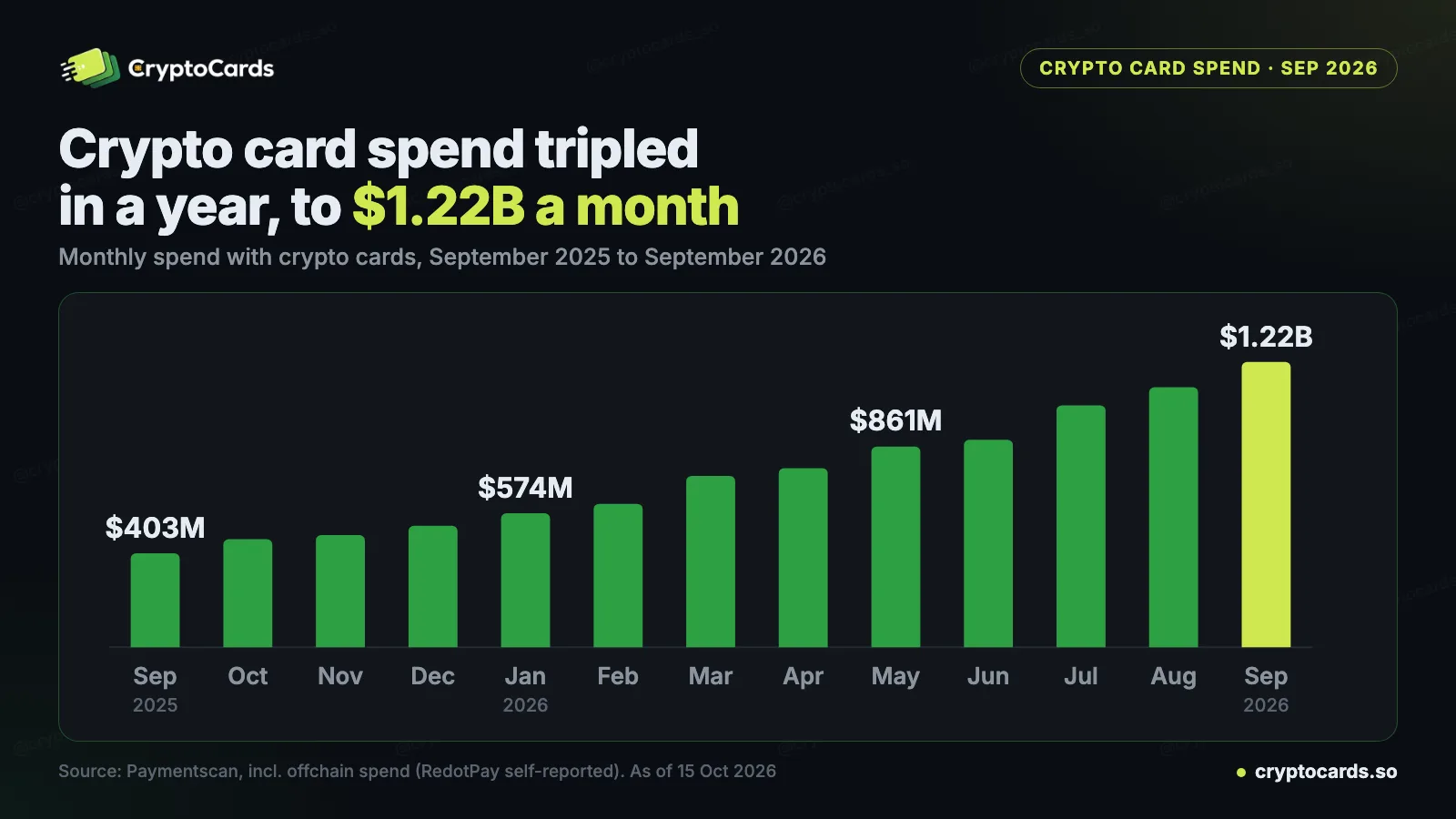
- $1.22B was spent with crypto cards in September 2026. That's a record, and 3x September 2025.
- Spend has hit a new record every month since May 2024. That's 29 months in a row.
- July 2026 was the first month above $1 billion.
- $7.8B was spent from January to September 2026. That's already more than double all of 2025 ($3.8B).
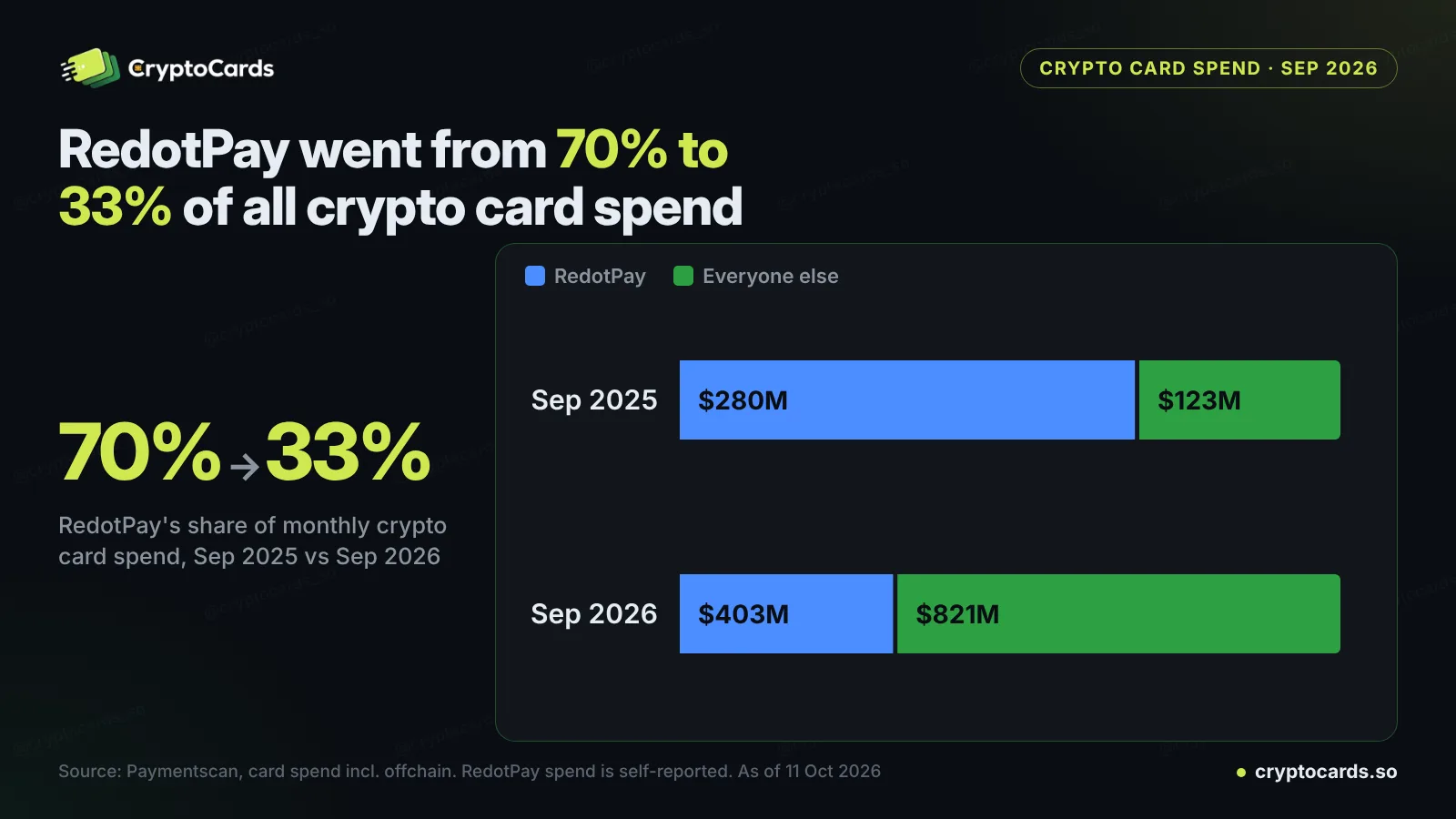
- RedotPay went from 70% to 33% of all card spend in a year. It still grew. Everyone else just grew a lot faster.
- USDC is 54% of onchain card spend. USDT is 17%.
- Visa handles 96% of the money, even though a quarter of the cards we list run on Mastercard.
- Base settles more card spend than any other blockchain: $225M in September.
- Cards that advertise up to 4% or 8% cashback actually paid out 0.9% to 2.4% of what people spent.
On this page
- How much is spent with crypto cards each month
- The biggest crypto cards by spend
- RedotPay's market share: 70% to 33% in a year
- Fastest-growing crypto cards
- Cards losing ground
- Average purchase size
- Which stablecoins people spend
- Which blockchains crypto cards settle on
- Visa vs. Mastercard
- Cashback: advertised vs. actually paid
- Who issues the cards
- What's on the market
- How we collect these numbers
- FAQ
People spent $1.22 billion with crypto cards in September 2026. A year earlier it was $403 million.
We follow this market every week for our posts on X, and we kept getting the same questions. How big is it? Which cards do people actually use? Is the cashback real? So we put all the numbers in one place.
How much is spent with crypto cards each month
| Month | Card spend | vs. previous month | Transactions |
|---|---|---|---|
| Sep 2026 | $1.224B | +9.7% | 11.5M |
| Aug 2026 | $1.116B | +7.5% | 11.1M |
| Jul 2026 | $1.038B | +16.6% | 10.6M |
| Jun 2026 | $890M | +3.4% | 9.7M |
| May 2026 | $861M | +12.0% | 9.8M |
| Apr 2026 | $768M | +4.5% | 9.3M |
| Mar 2026 | $735M | +19.5% | 9.0M |
| Feb 2026 | $615M | +7.1% | 7.7M |
| Jan 2026 | $574M | +10.2% | 7.4M |
| Dec 2025 | $521M | +8.4% | 6.7M |
| Nov 2025 | $481M | +3.7% | 6.1M |
| Oct 2025 | $464M | +15.0% | 6.0M |
| Sep 2025 | $403M | 5.7M |
What stands out:
Growth is steady, not spiky. Over the last 12 months spend grew about 10% a month on average, and not a single month went backwards.
Spend tripled, transactions doubled. So people aren't only paying more often, the average payment got bigger too. More on that in average purchase size.
By year
| Year | Card spend |
|---|---|
| 2023 (from March) | about $15M |
| 2024 | $828M |
| 2025 | $3.80B |
| 2026 (to mid-October) | $8.45B |
In total, crypto cards have processed $13.1 billion in spend since March 2023.
October so far
$627M was spent in the first half of October. That's ahead of September's daily pace, so October is on track for another record. We'll add the final number here in early November.
The biggest crypto cards by spend
September 2026, all tracked card programs:
| # | Card | Spend | Market share | vs. August | vs. Sep 2025 |
|---|---|---|---|---|---|
| 1 | RedotPay* | $403.2M | 32.9% | 0% | +44% |
| 2 | EtherFi | $128.8M | 10.5% | +18% | 5.4x |
| 3 | KAST | $113.8M | 9.3% | +9% | 8.9x |
| 4 | Karta | $49.5M | 4.0% | +13% | 16x |
| 5 | Wirex One | $47.6M | 3.9% | +36% | new in 2026 |
| 6 | Plasma One | $25.6M | 2.1% | +29% | new in 2026 |
| 7 | Kolo | $19.6M | 1.6% | +10% | 16x |
| 8 | Tria | $16.8M | 1.4% | +19% | 107x |
| 9 | Karta.io | $16.7M | 1.4% | +8% | 5.1x |
| 10 | Coca | $9.3M | 0.8% | +17% | new in 2026 |
| 11 | Gnosis Pay | $7.6M | 0.6% | -9% | -32% |
| 12 | Avici | $3.8M | 0.3% | +6% | 16x |
* RedotPay's spend is self-reported by RedotPay. Everything else in this table is read onchain.
A few things worth knowing:
RedotPay is still the largest. It's bigger than the next six cards on this list combined.
But it didn't grow in September. It was flat at $403M while almost every other big card grew.
EtherFi and KAST are both above $100M a month now. A year ago they did $24M and $13M.
RedotPay's market share: 70% to 33% in a year
| Sep 2025 | Sep 2026 | |
|---|---|---|
| RedotPay | $280M (70%) | $403M (33%) |
| Every other card | $123M (30%) | $821M (67%) |
| Total | $403M | $1.224B |
RedotPay didn't shrink. It grew 44% in a year. The rest of the market grew almost 7x in the same time.
Most of that new money went to cards that either launched or took off in the last 12 months: EtherFi, KAST, Wirex One and Plasma One. A year ago one card had 70% of the market. Today no card has more than a third.
Fastest-growing crypto cards
Cards that were already live a year ago (September 2025 vs. September 2026):
| Card | Sep 2025 | Sep 2026 | Growth |
|---|---|---|---|
| Tria | $0.16M | $16.8M | 107x |
| Karta | $3.1M | $49.5M | 16x |
| Kolo | $1.2M | $19.6M | 16x |
| Avici | $0.24M | $3.8M | 16x |
| KAST | $12.8M | $113.8M | 8.9x |
| EtherFi | $24.1M | $128.8M | 5.4x |
| Karta.io | $3.3M | $16.7M | 5.1x |
Tria had only been live for three months in September 2025, which is why its number looks so extreme. KAST and EtherFi are the more impressive ones, because they grew that fast from an already big base.
Cards that launched in 2026 (June vs. September):
| Card | June 2026 | Sep 2026 | Growth |
|---|---|---|---|
| Wirex One | $1.9M | $47.6M | 25x |
| Plasma One | $9.0M | $25.6M | 2.9x |
| Coca | $6.2M | $9.3M | 1.5x |
| Ethena Pay | $0.06M (July) | $1.6M | 25x |
Wirex One went from a test-sized card to the fifth biggest in the market in three months.
Cards losing ground
Not everyone is growing. Two of the first self-custodial cards are clearly shrinking:
| Card | Peak month | Peak spend | Sep 2026 | Change | Active wallets |
|---|---|---|---|---|---|
| MetaMask | Oct 2025 | $6.0M | $2.5M | -58% | down 51% from peak |
| Gnosis Pay | Oct 2025 | $12.05M | $7.6M | -37% | down 34% from peak |
| Bitget Wallet | Jun 2026 | $5.2M | $1.8M | -65% | down 62% from peak |
Being early wasn't enough. Our guess is rewards. Gnosis Pay's cashback depended on how much GNO you held, while EtherFi pays 3% from its entry tier. When the newer cards pay more and ask for less, people move.
Since then, Gnosis Pay has announced that its consumer card and web app will close on 20 December 2026, as it moves to running card programs for other wallets and apps.
Average purchase size
How much people spend per transaction, September 2026:
| Card | Avg. purchase, Sep 2026 | Sep 2025 |
|---|---|---|
| Avici | $166 | $112 |
| Tria | $145 | $116 |
| Wirex One | $106 | not live yet |
| EtherFi | $81 | $73 |
| Coca | $67 | not live yet |
| RedotPay | $60 | $61 |
| MetaMask | $53 | $61 |
| Gnosis Pay | $47 | $56 |
Across all cards where each purchase shows up as its own transaction, the average purchase was about $89 in September, up from about $67 a year earlier.
The newer cards get the bigger purchases. Wirex One, Tria and Avici all sit well above $100.
RedotPay hasn't moved. $61 a year ago, $60 now.
The shrinking cards are also seeing smaller purchases. MetaMask and Gnosis Pay both went down.
We leave out KAST, Karta, Karta.io and Kolo here because they settle purchases in batches, so their transaction counts don't match real purchases. Plasma One is left out too: it records one transaction per user per day, which would make its average look bigger than it is.
Which stablecoins people spend
Onchain card spend by stablecoin, September 2026:
| Stablecoin | Spend | Share |
|---|---|---|
| USDC | $439.2M | 53.6% |
| USDT | $141.6M | 17.3% |
| EURC | $70.0M | 8.5% |
| liquidUSD | $12.1M | 1.5% |
| EURe | $5.8M | 0.7% |
| Other | $151.1M | 18.4% |
| Total onchain | $819.8M |
USDC is 3x USDT. But it wasn't always like that. USDT was actually the most spent stablecoin for three months, from November 2025 to January 2026. Then USDC pulled away.
EURC grew 38x in a year, from $1.9M to $70.0M a month.
Euro spending didn't go anywhere, it switched coins. In July 2024, EURe was about 45% of all onchain card spend. Today it's under 1%, and EURC took its place.
Which blockchains crypto cards settle on
Onchain card spend by settlement chain:
| Chain | Sep 2026 | Share | Sep 2025 | Growth |
|---|---|---|---|---|
| Base | $225.3M | 27.5% | $14.6M | 15x |
| Optimism | $132.1M | 16.1% | $3.1M | 42x |
| Solana | $113.9M | 13.9% | $6.2M | 18x |
| Stellar | $71.7M | 8.7% | $0.9M | 78x |
| Arbitrum | $61.8M | 7.5% | $8.0M | 7.7x |
| Polygon | $52.8M | 6.4% | $31.0M | 1.7x |
| Ethereum | $50.7M | 6.2% | $14.1M | 3.6x |
| Other chains | $111.4M | 13.6% | $43.2M | 2.6x |
| Total onchain | $819.8M | $121.1M | 6.8x |
A year ago Polygon was number one, settling twice as much as Base. Now Base settles 4x more than Polygon.
Optimism's 42x is mostly EtherFi. Its card settles on Optimism now, after moving over from Scroll.
Two new chains are already big. Arc, where Wirex One settles, did $51.0M in the last 30 days. Plasma, home of Plasma One, did $44.8M. Both are inside "Other chains" in the table.
Visa vs. Mastercard
Card spend by payment network, September 2026:
| Network | Spend | Share |
|---|---|---|
| Visa | $1.176B | 96.2% |
| Mastercard | $46.6M | 3.8% |
Mastercard just had its best month ever. $46.6M in September, double August and 4x a year ago.
October started even stronger for Mastercard, with 4.8% of spend in the first half of the month.
The gap is about where the big cards are, not how many cards there are. On our site, 74% of listed cards run on Visa and 24% on Mastercard. So Mastercard has about a quarter of the cards but under 4% of the money. RedotPay, EtherFi and KAST all run on Visa.
Cashback: advertised vs. actually paid
Cashback paid onchain as a share of card spend, August 2026:
| Card | Advertised | Actually paid |
|---|---|---|
| EtherFi | 3% (4% on the top tier) | 2.4% |
| Plasma One | 2% to 4%, by tier | 2.1% |
| Wirex One | 0.5% to 8%, by tier | 1.5% |
| Gnosis Pay | up to 4%, depends on GNO held | 0.9% |
Why the gap? The top rates usually need a paid tier or a big token holding, and most cards cap or lower the rate after a monthly spending limit. So "up to 8%" is real, but few people get it. The "actually paid" column is a lot closer to what a normal user earns.
Why August? EtherFi switched to claim-based cashback in September, so its September payouts don't show what it actually owes users yet.
A few more numbers:
Crypto cards have paid $32.5M in cashback onchain since September 2024.
The biggest month so far was August 2026, with $3.67M.
In September, Wirex One ($599K) and Plasma One ($479K) both paid out record amounts.
Who issues the cards
Most crypto card brands don't issue cards themselves. A licensed issuer does it in the background. Onchain spend over the last 30 days:
| Issuer | Spend, last 30 days | Approx. share of onchain spend |
|---|---|---|
| Rain | $565.8M | about 65% |
| Wirex | $226.6M | about 26% |
| Immersve | $54.9M | about 6% |
| Bridge | $2.6M | under 1% |
Rain sits behind roughly two out of every three onchain card dollars. Immersve is the one to watch: its volume more than doubled in the last 30 days.
What's on the market
We review 129 crypto cards on CryptoCards.so (123 personal, 6 business). Here's what they look like:
| Feature | Share of cards |
|---|---|
| Offer a virtual card | 89% |
| Marketed as available worldwide (usually with some excluded countries) | 85% |
| Work with Apple Pay | 77% |
| Work with Google Pay | 77% |
| Run on Visa | 74% |
| Offer a physical card | 54% |
| Don't require KYC | 22% |
Most cards are free to hold. 95 of the 115 cards with a published fee schedule charge no monthly fee.
The typical FX fee is 1%. That's the median across the 76 cards that publish one, and 26 of them charge nothing.
No-KYC cards are a minority, about one in five. You can see them all on our no-KYC cards page.
How we collect these numbers
Spend data comes from Paymentscan, which tracks 29 crypto card programs. For most of them it reads the actual settlement transactions onchain.
Totals, card rankings and Visa vs. Mastercard include offchain spend that RedotPay and BFinance report themselves. Chain and stablecoin numbers are onchain only (25 of 29 programs), which is why they add up to $819.8M rather than $1.224B.
We count spend only. Top-ups, transfers and withdrawals are left out.
Some programs settle in batches (KAST, Karta, Karta.io, Kolo), so one onchain transaction can cover many purchases. We exclude them from purchase averages.
Cashback rates are cashback paid onchain in a month divided by card spend in the same month. Rewards paid in tokens are valued on the day they're paid.
Issuer shares are approximate, measured against total onchain spend over the same 30 days.
History can change. Paymentscan revises past months when it adds new programs. The numbers here are as of 15 October 2026, so they can differ slightly from our older posts.
Listing stats cover the 129 cards with full review pages on CryptoCards.so, as of 15 October 2026.
AI and editing: we use AI tools to help research and draft. An editor checks every fact, number and source before we publish or update this page.
Mistakes: if you spot one, tell us and we'll fix it. More in how we write our blog posts.
FAQ
How big is the crypto card market in 2026?
People spent $1.22 billion with crypto cards in September 2026, which works out to about $14.7 billion a year at that pace. Since March 2023, crypto cards have processed $13.1 billion in total.
Which crypto card is used the most?
RedotPay, by a wide margin. It processed $403M in September 2026, about a third of all tracked spend (self-reported). EtherFi ($129M) and KAST ($114M) are second and third, and they're the biggest cards measured fully onchain.
Is crypto card spending still growing?
Yes. It has set a new record every month since May 2024. September 2026 was up 9.7% on August and 3x on September 2025.
Which stablecoin is spent most with crypto cards?
USDC, with 54% of onchain card spend in September 2026. USDT is second with 17%. EURC is the biggest euro stablecoin at 8.5%.
Do crypto cards use Visa or Mastercard?
Both, but Visa handles 96% of the money. 74% of the cards we list run on Visa and 24% on Mastercard.
How much cashback do crypto cards really pay?
Less than the ads say. In August 2026 the cards we checked paid out between 0.9% and 2.4% of what users spent, while advertising rates of up to 4% or 8%.
Looking for a card? You can compare all 129 cards on CryptoCards.so by country, fees, cashback and KYC.